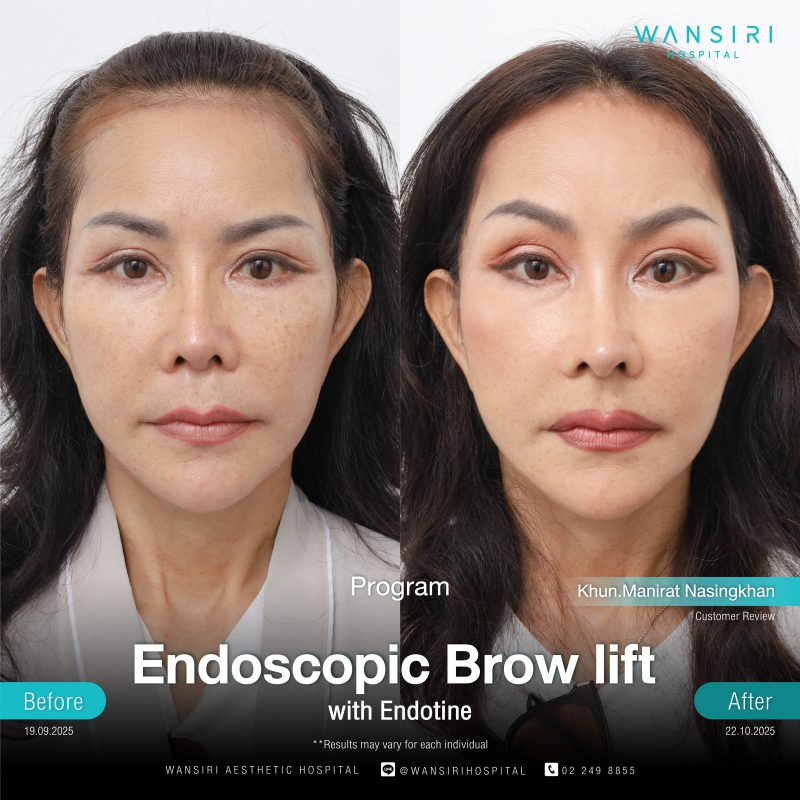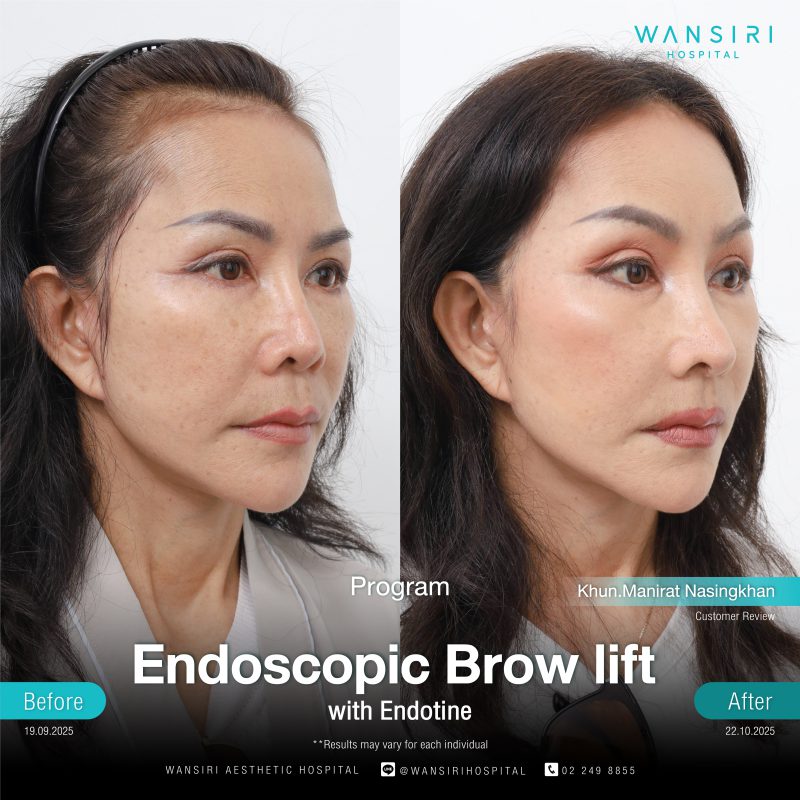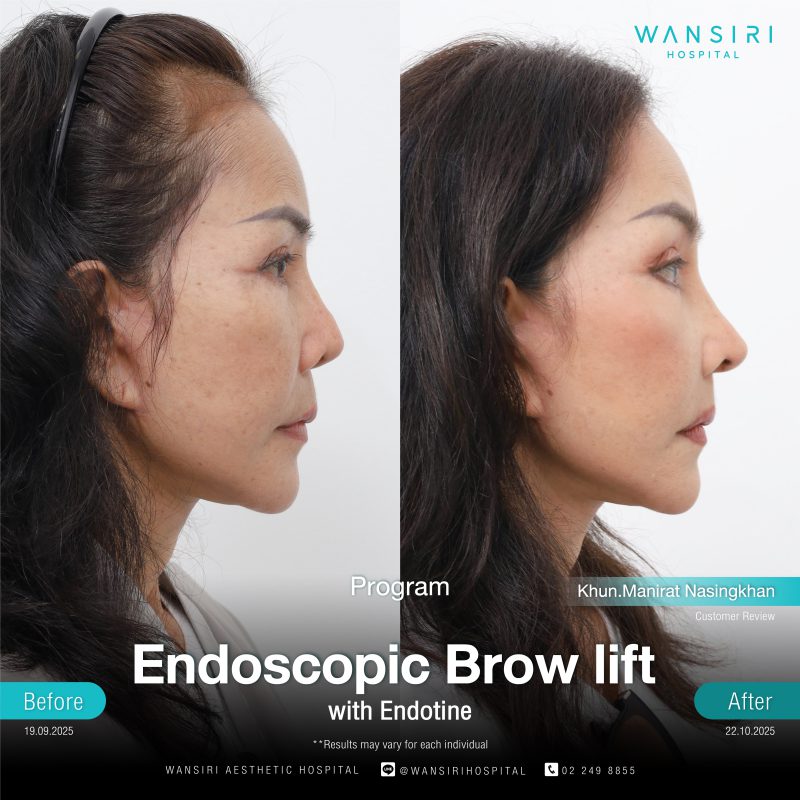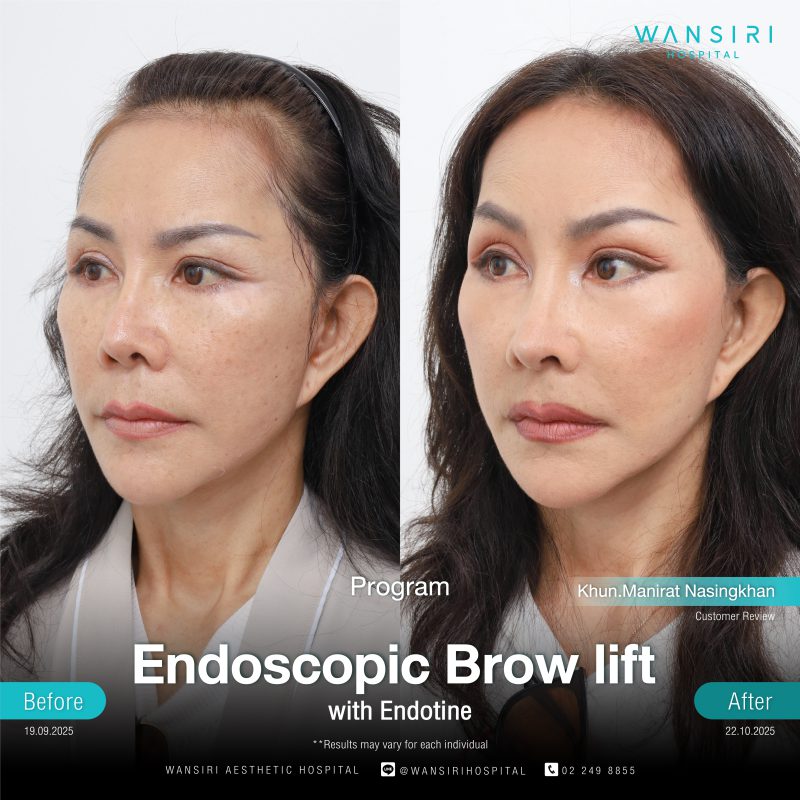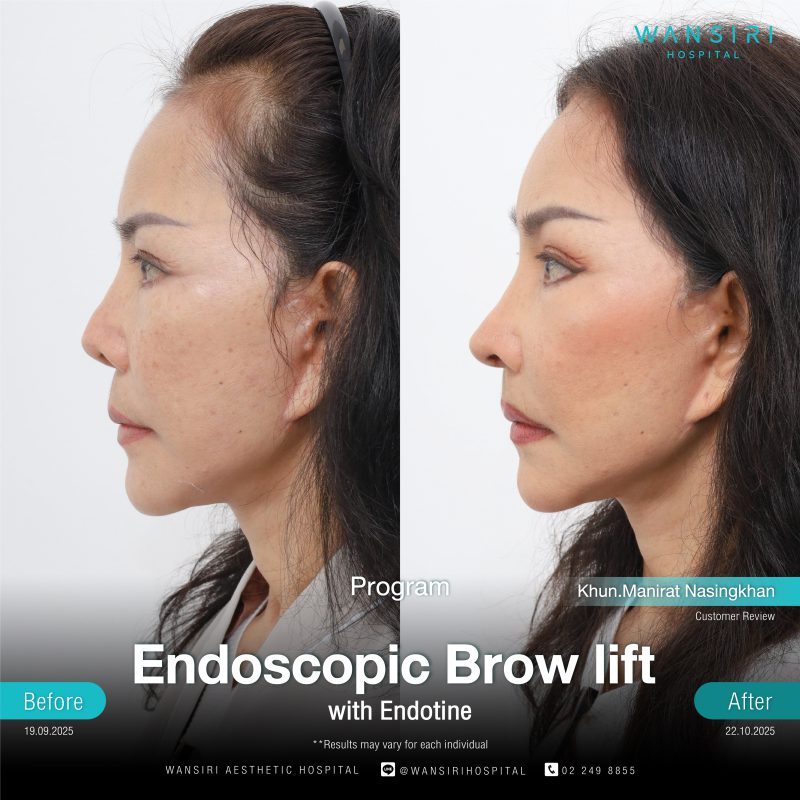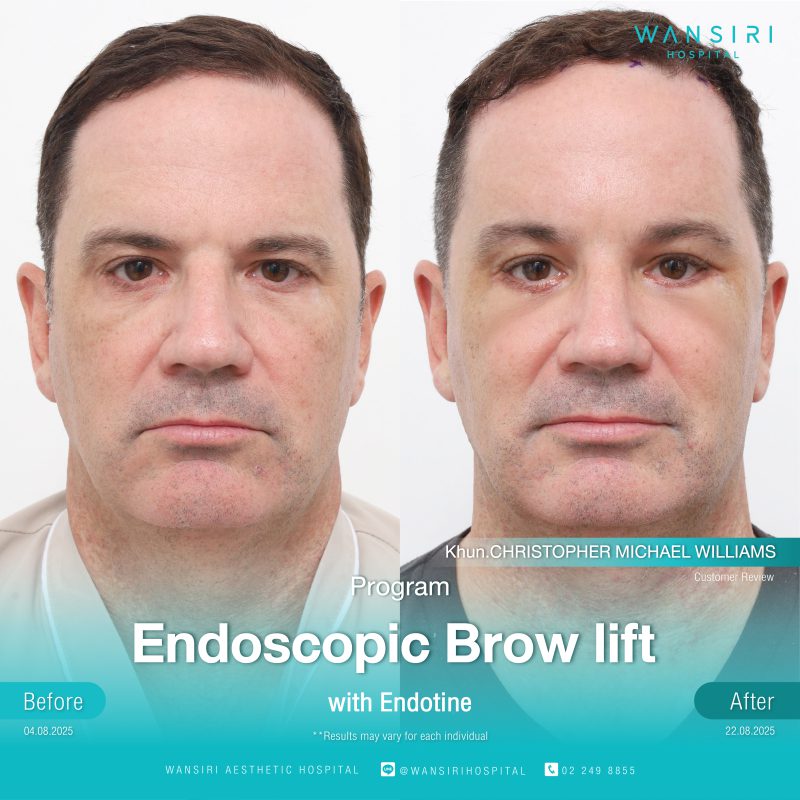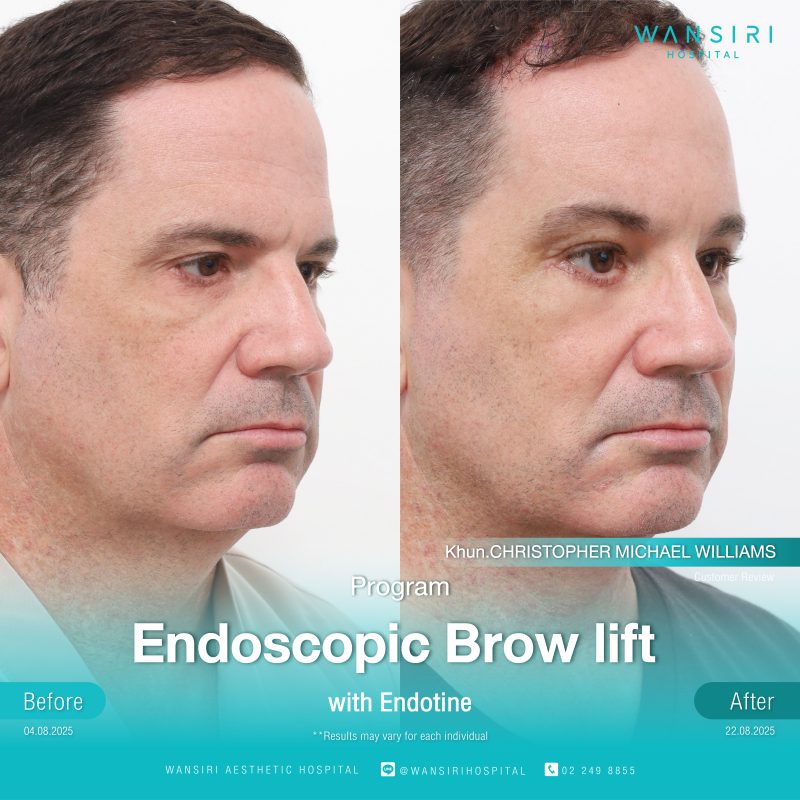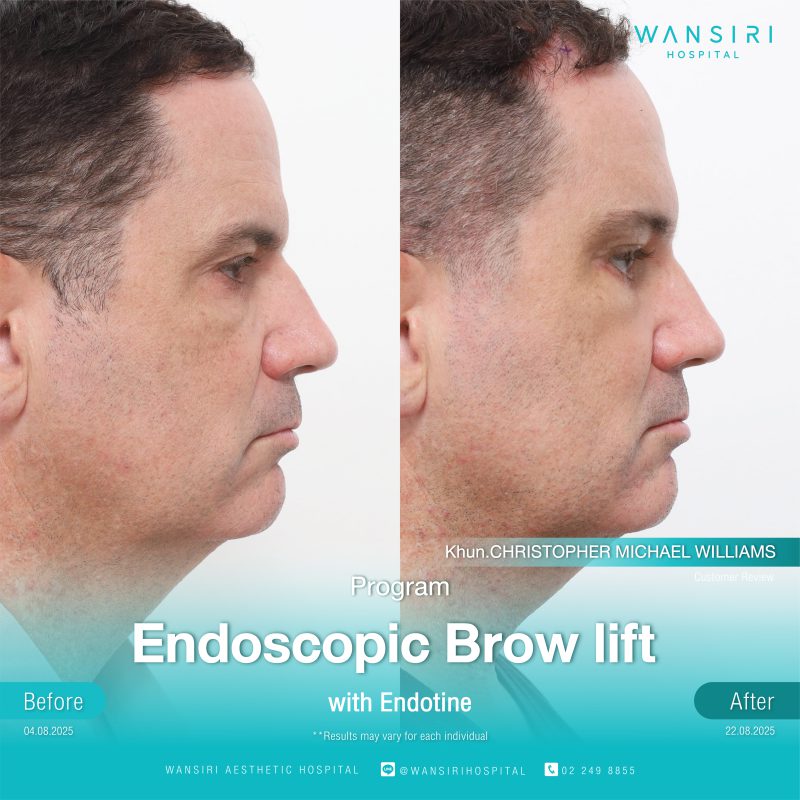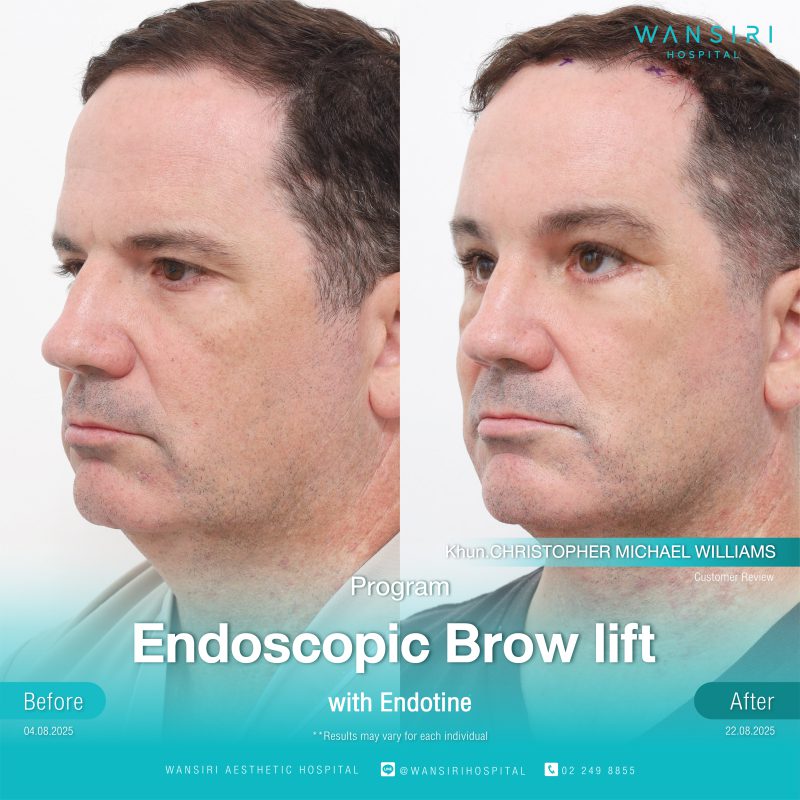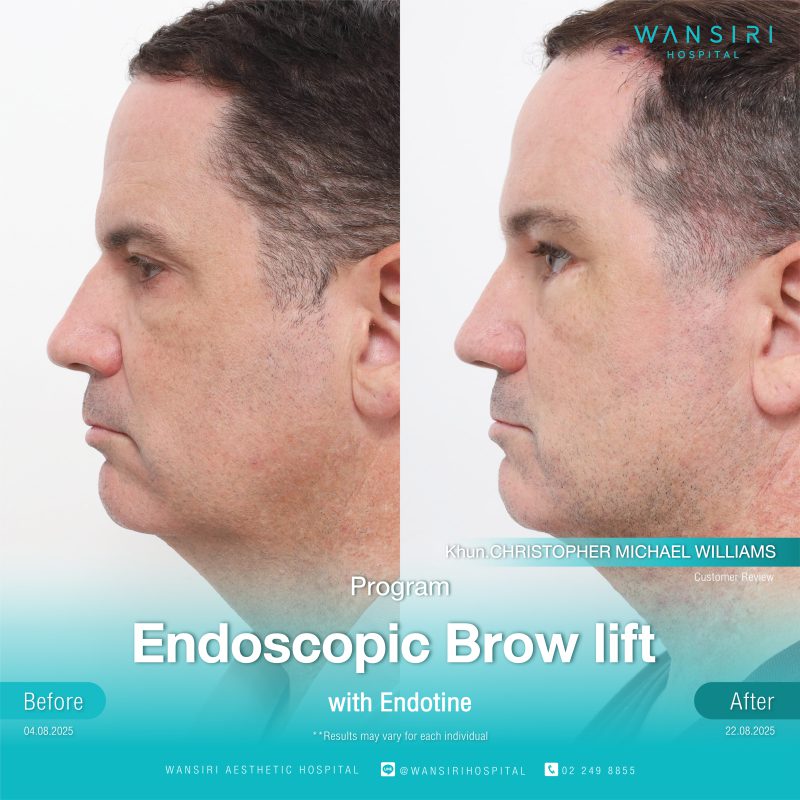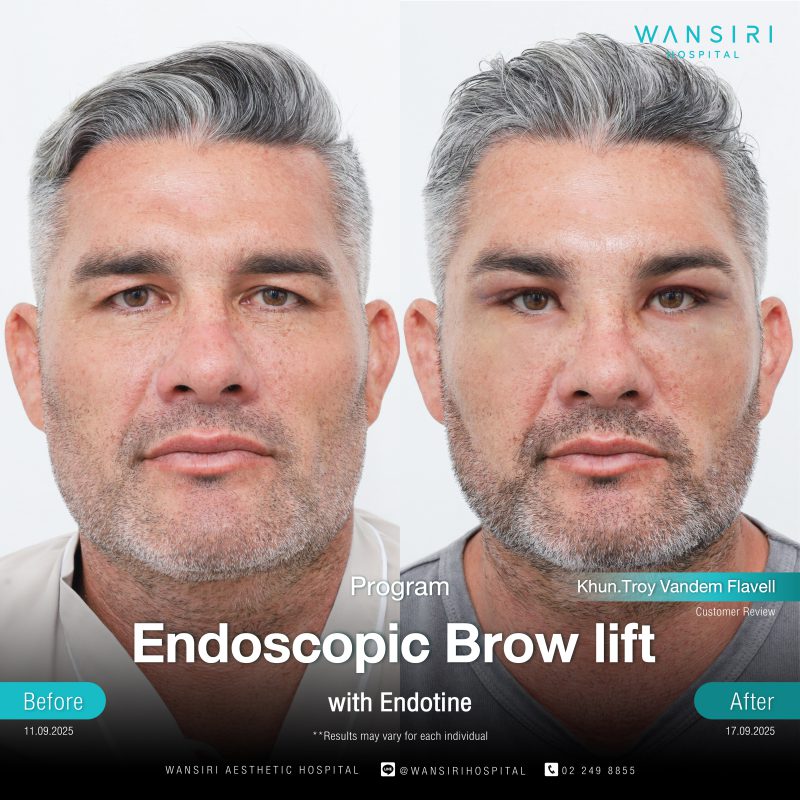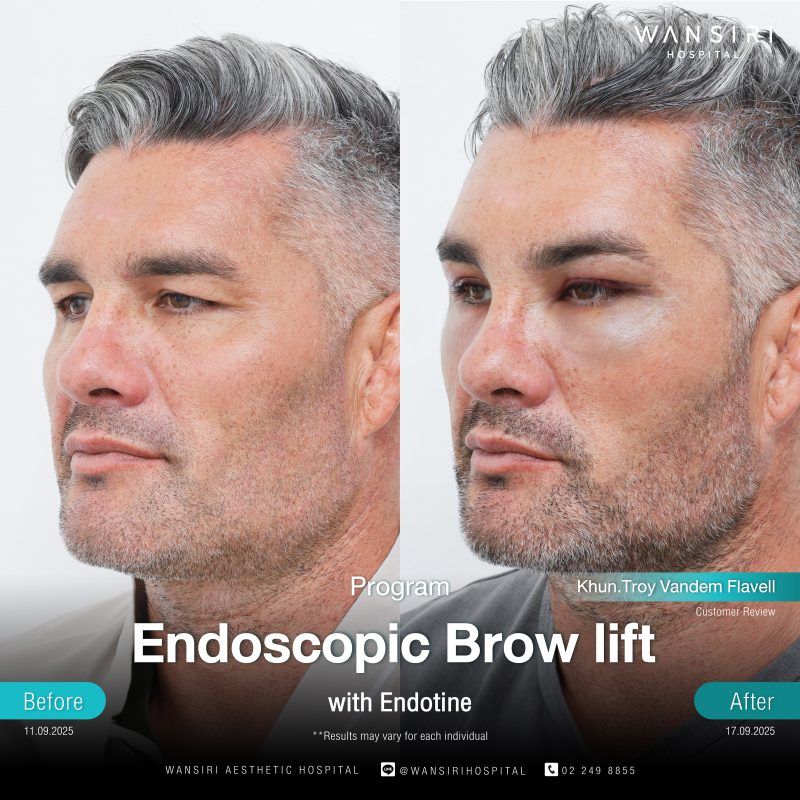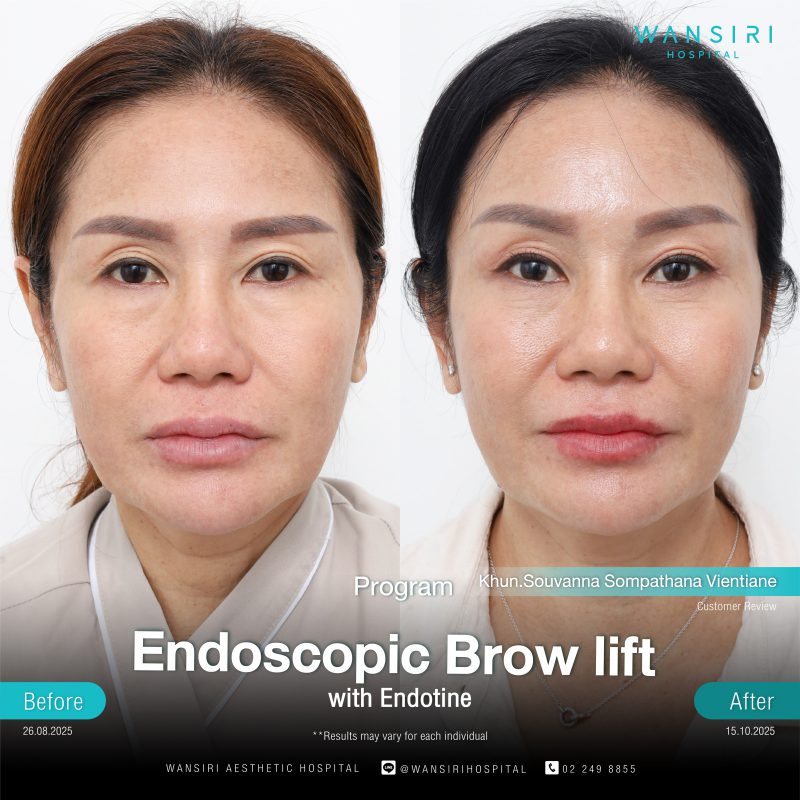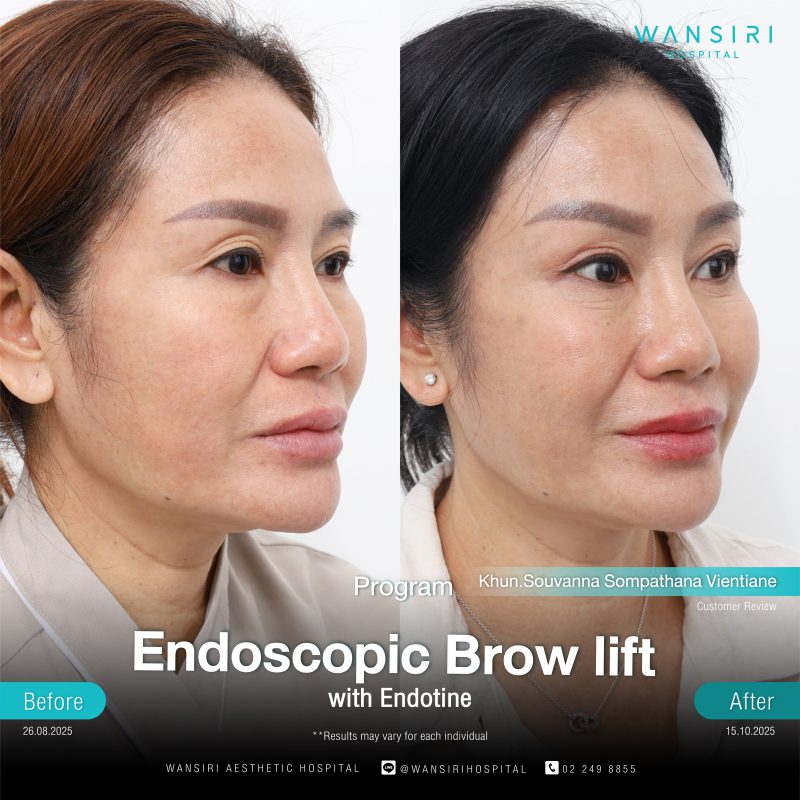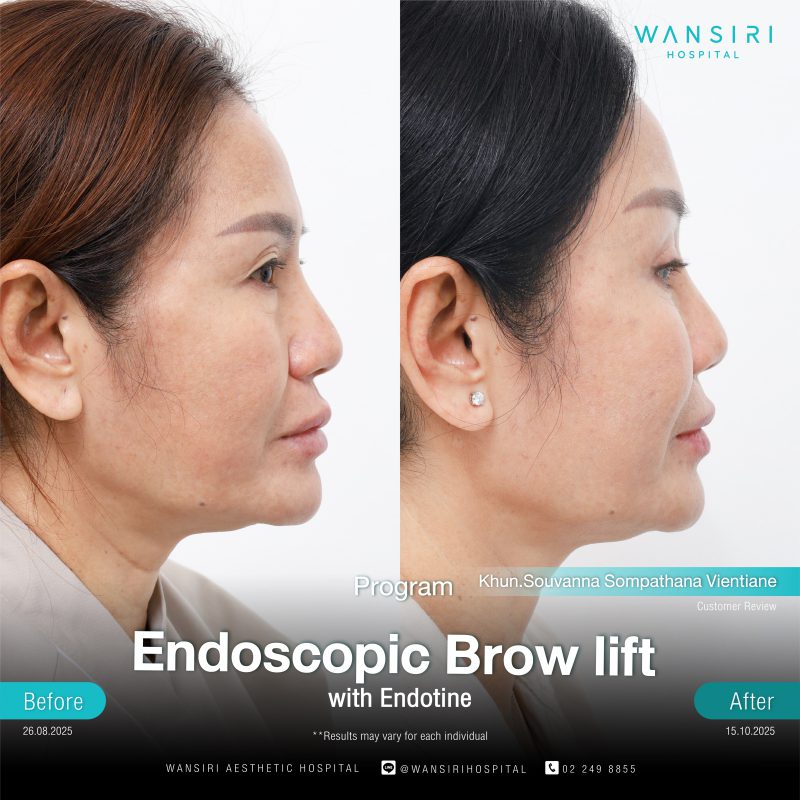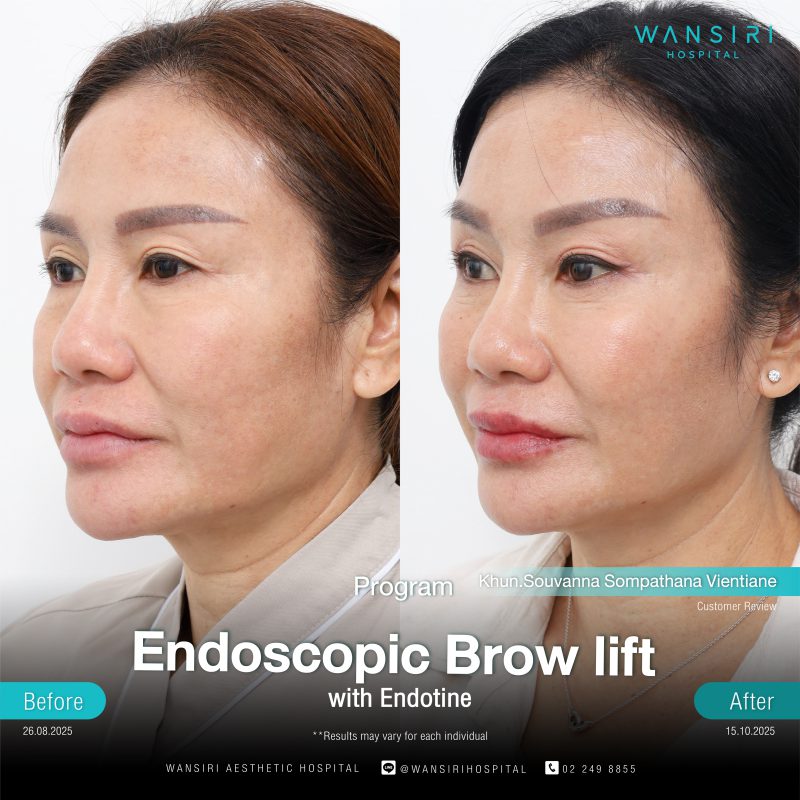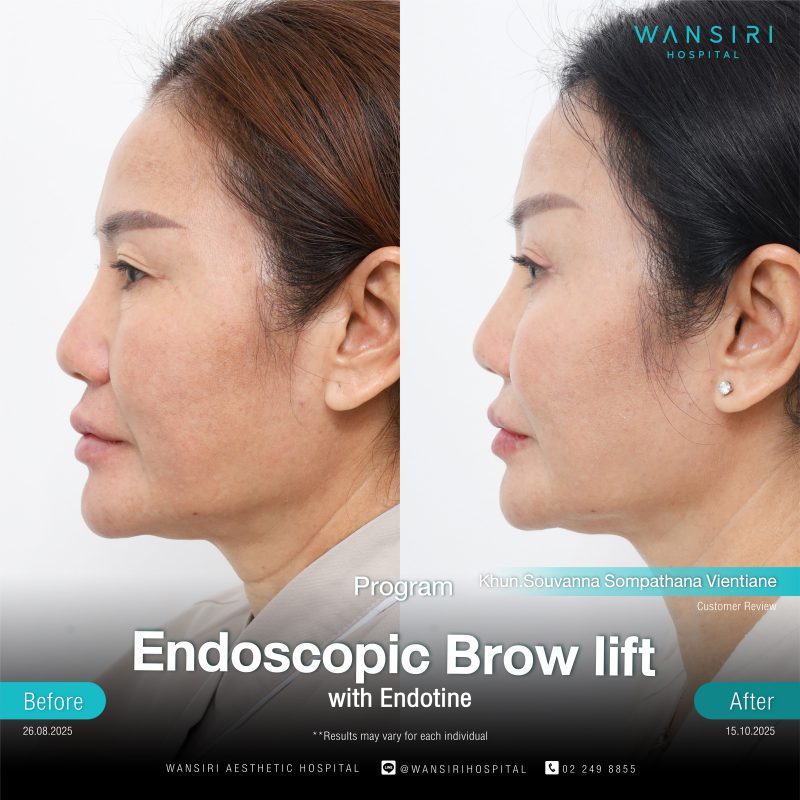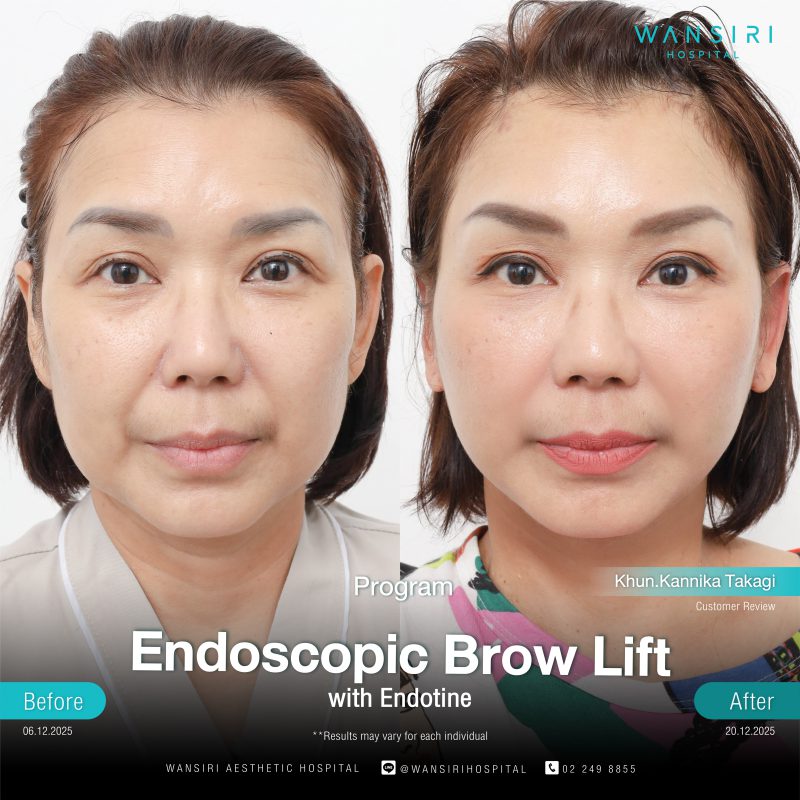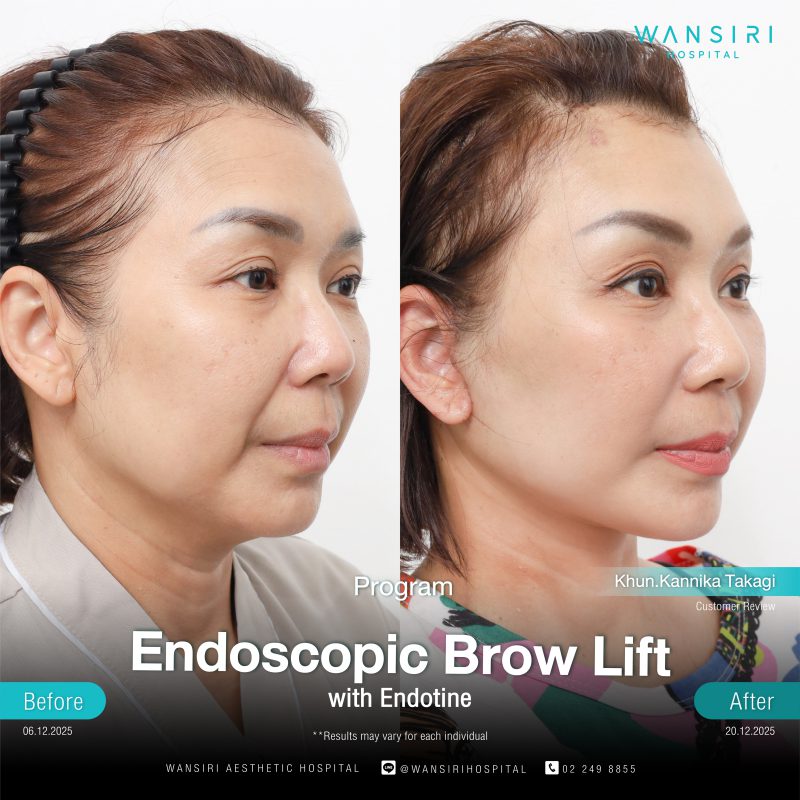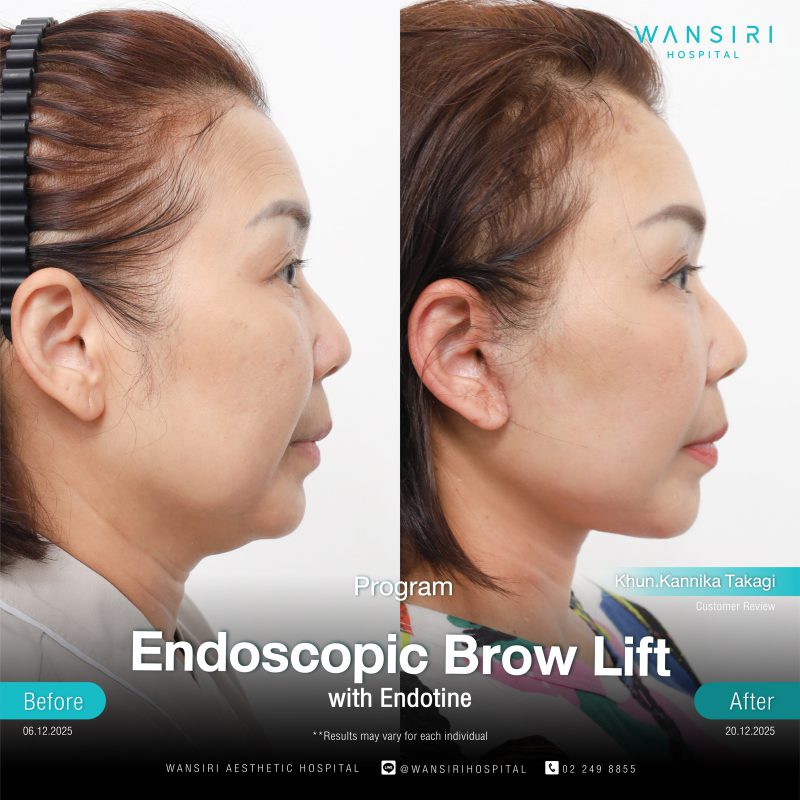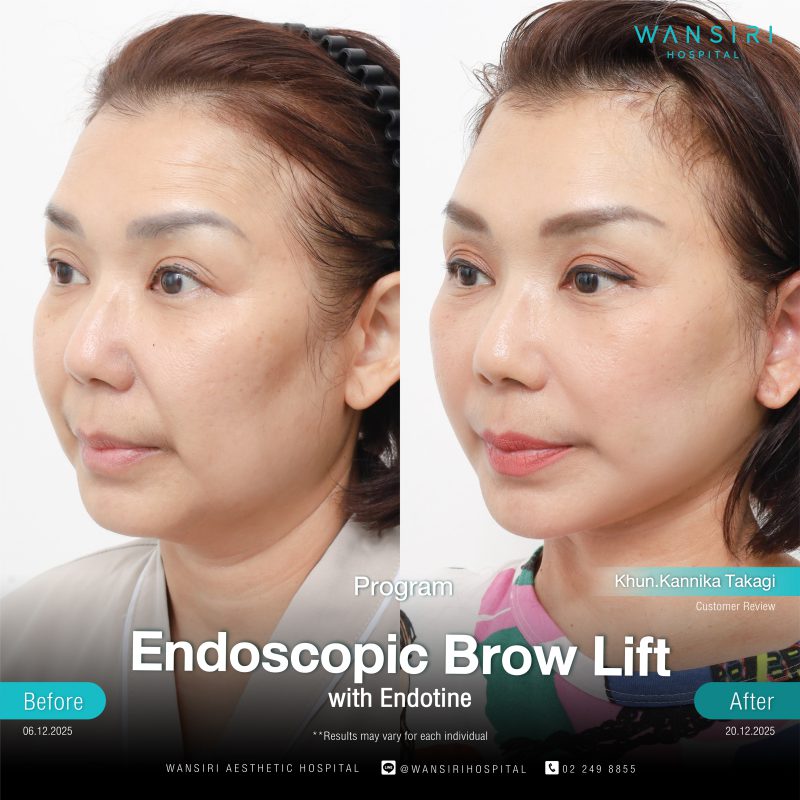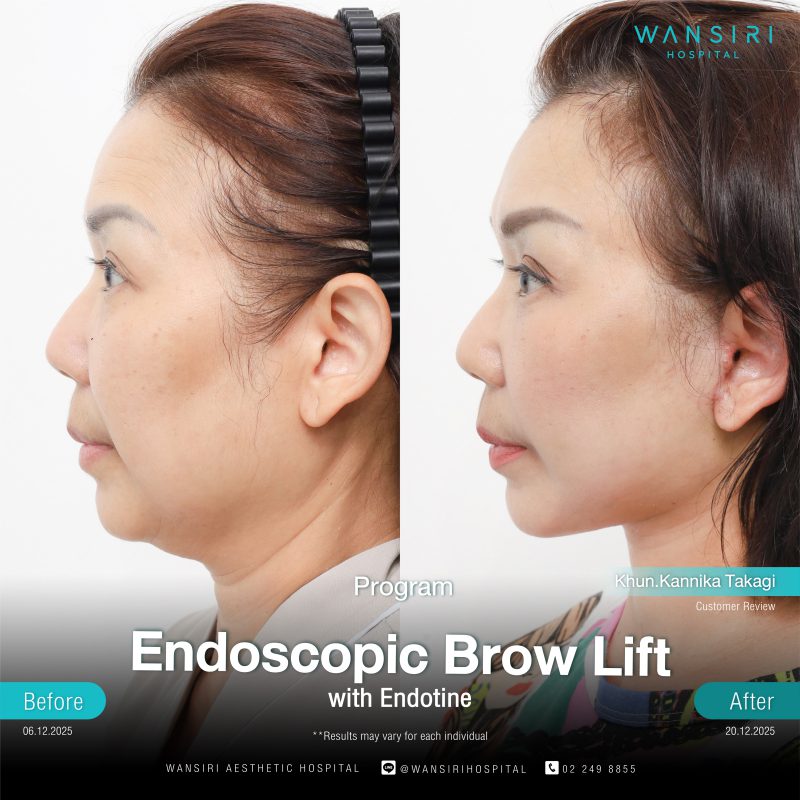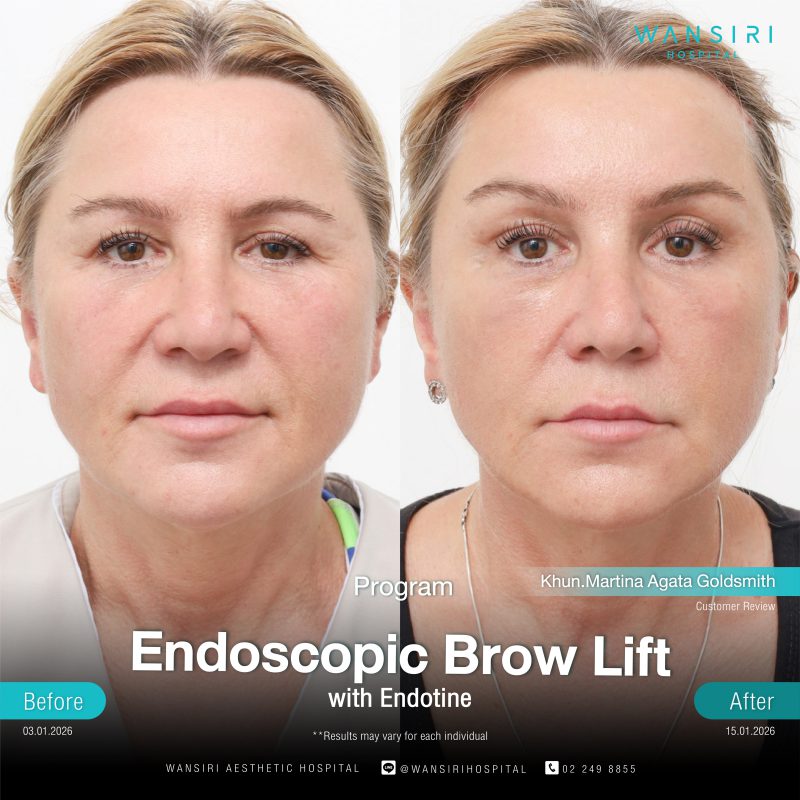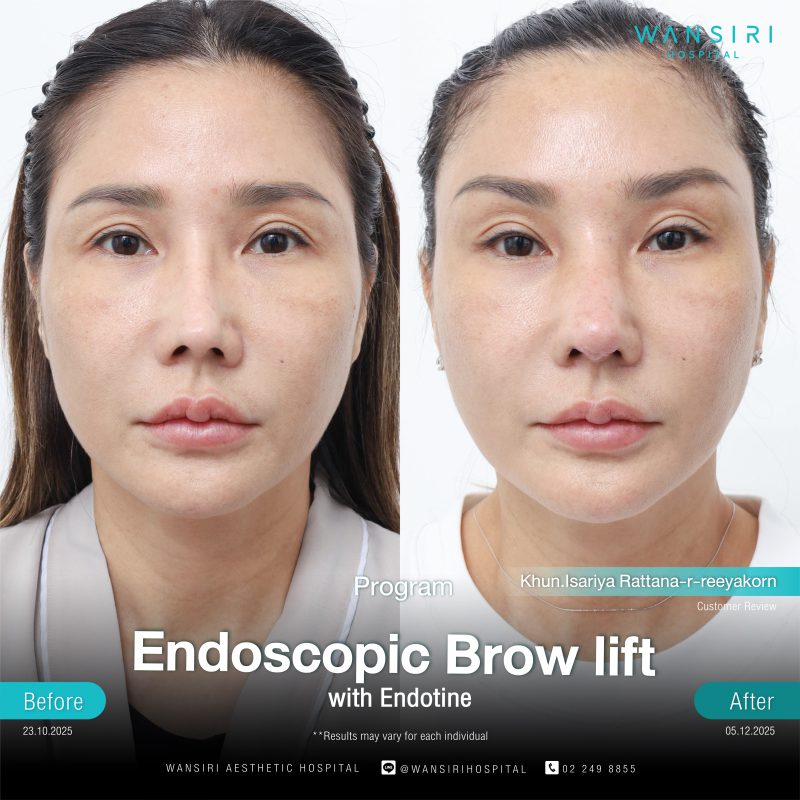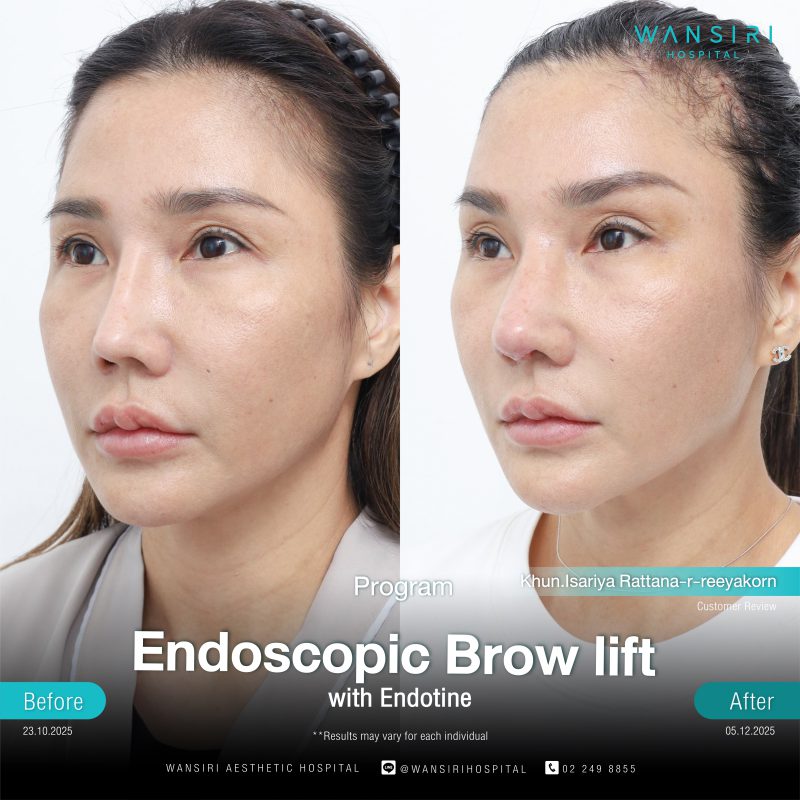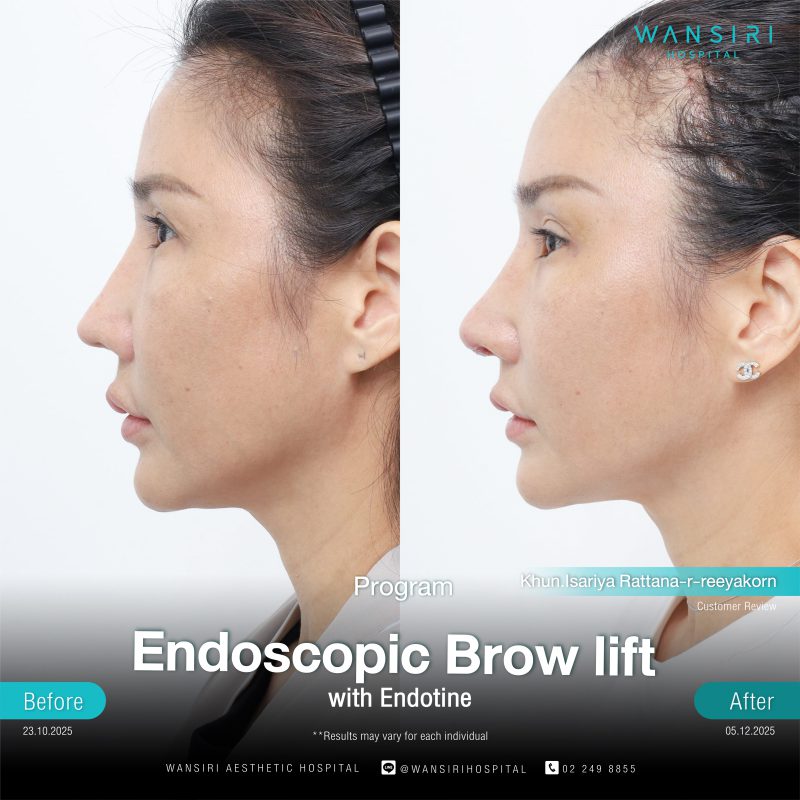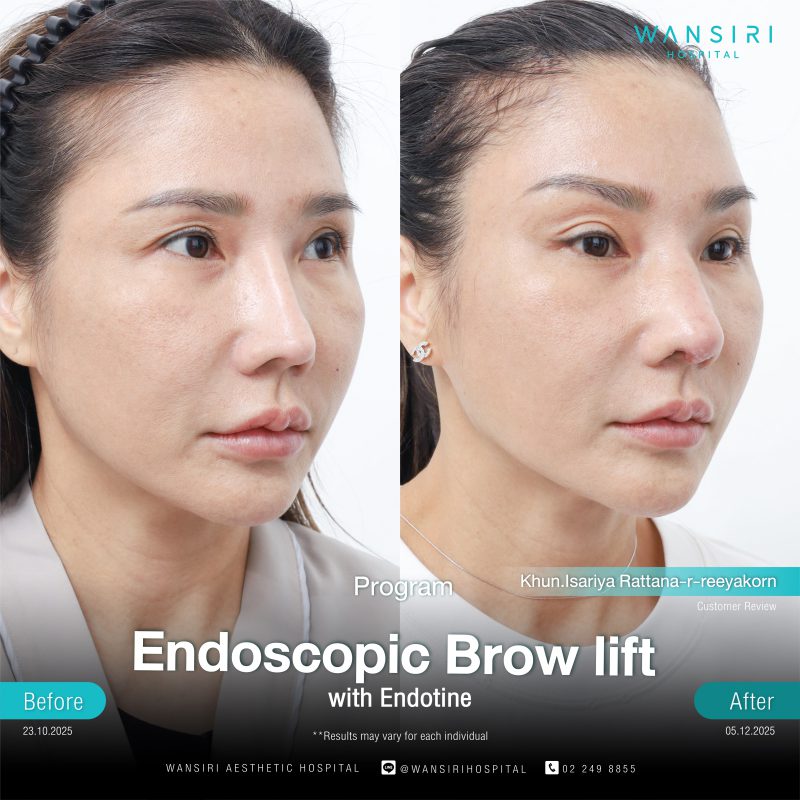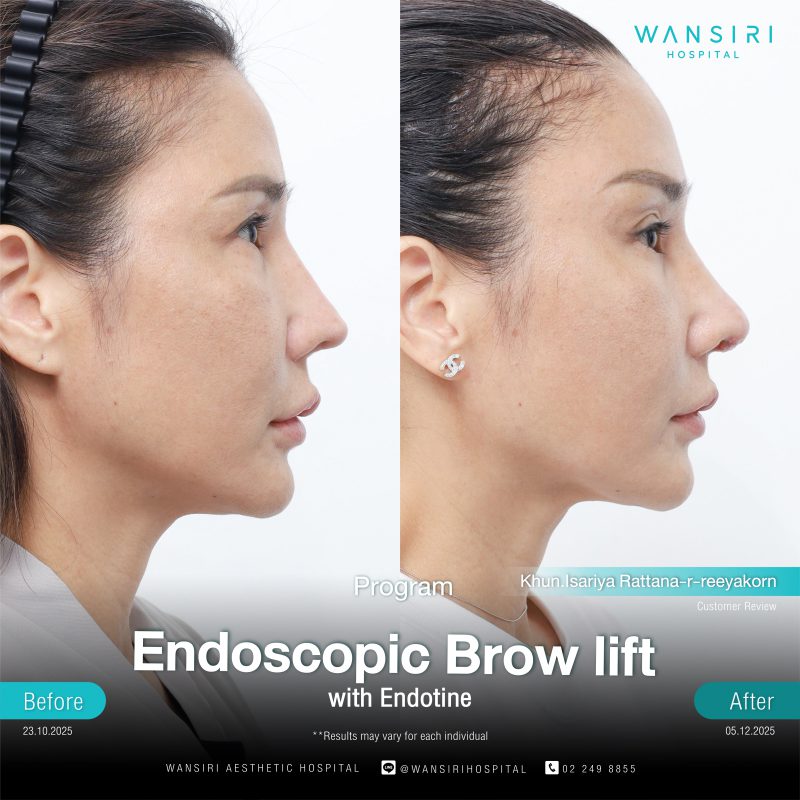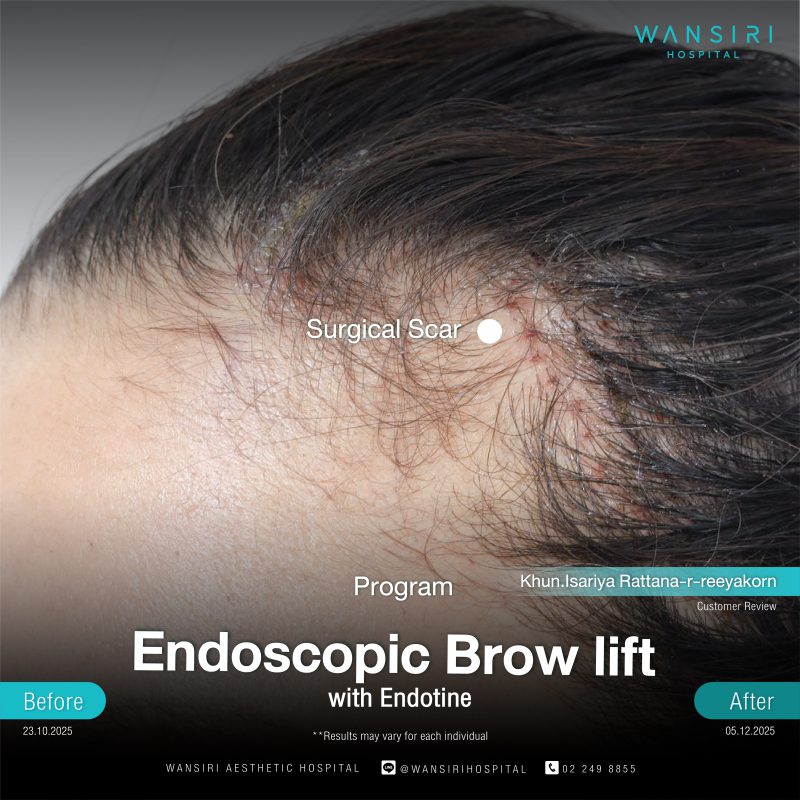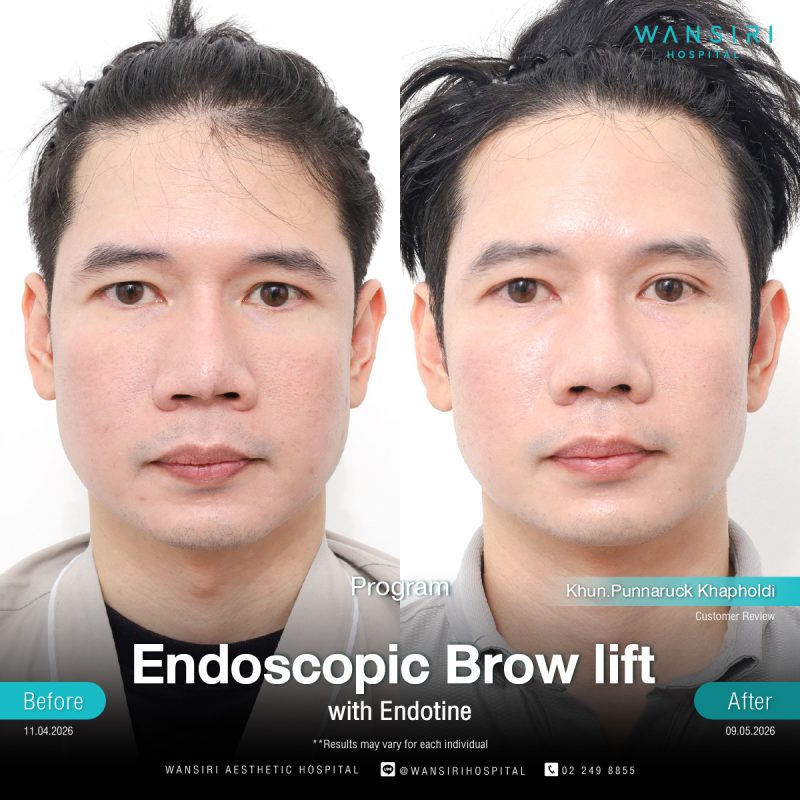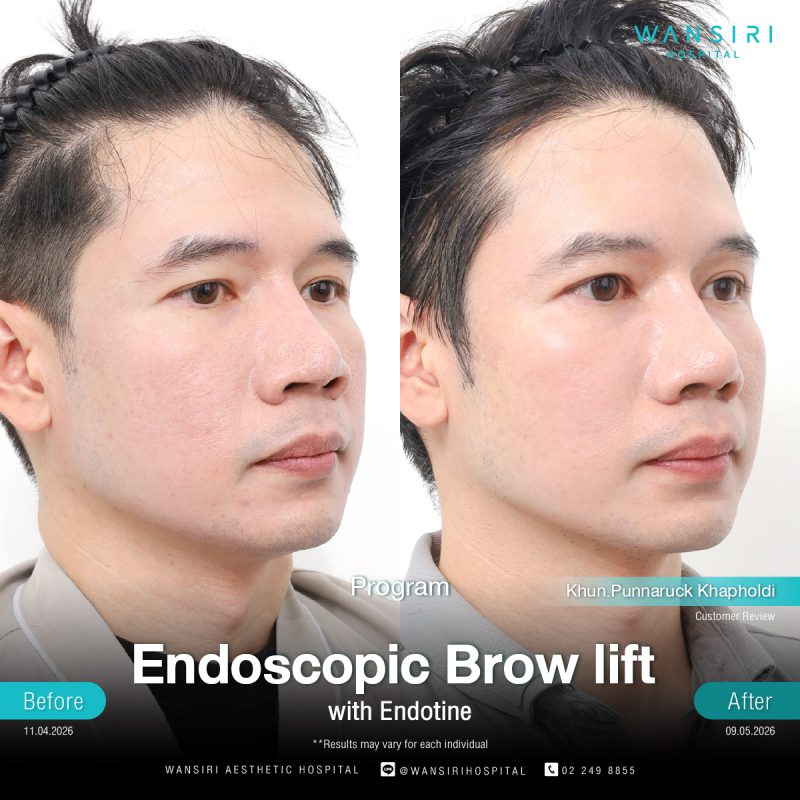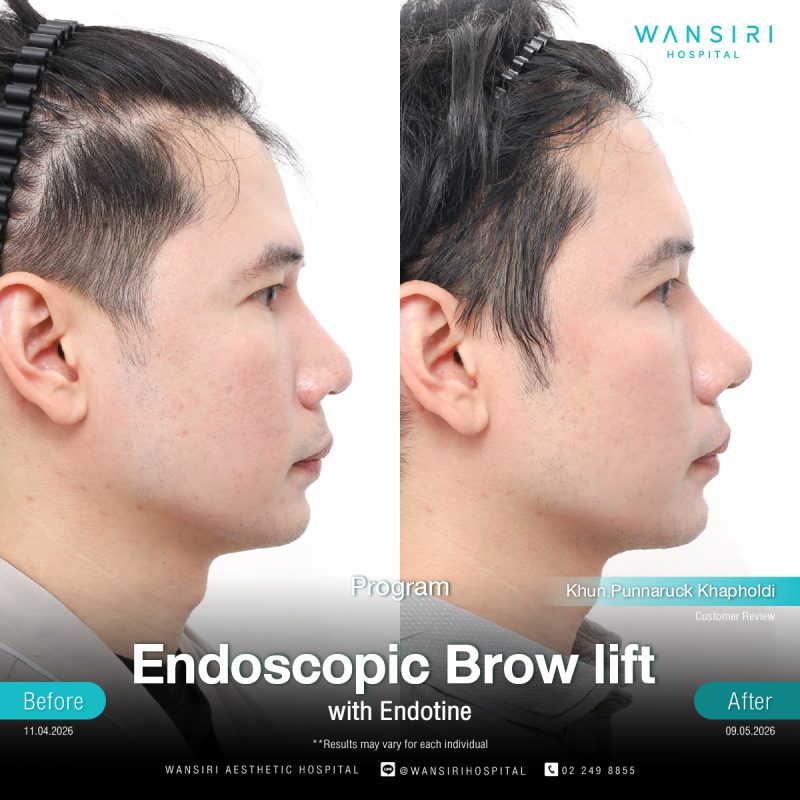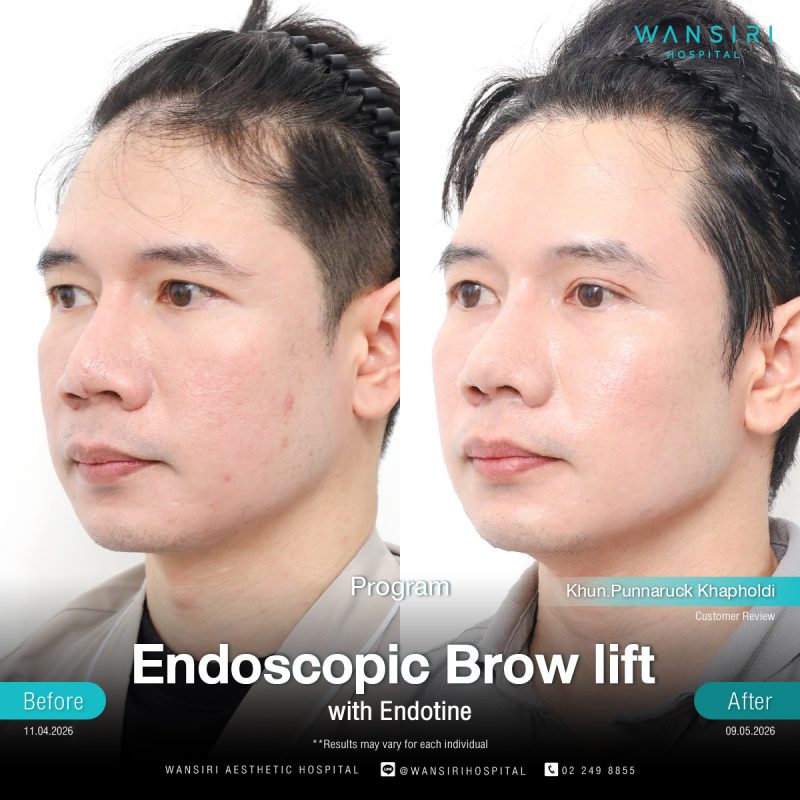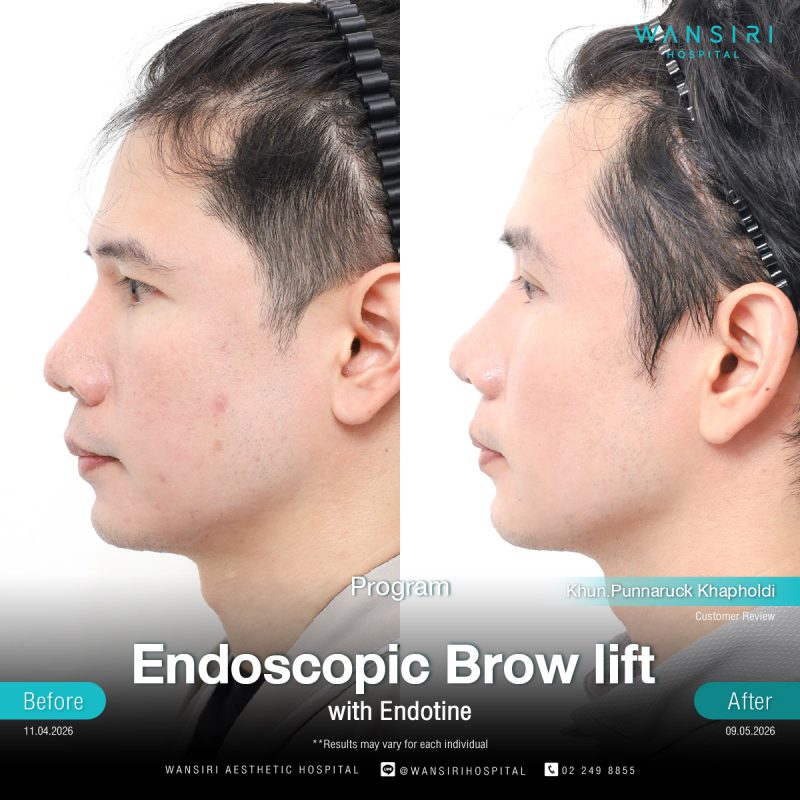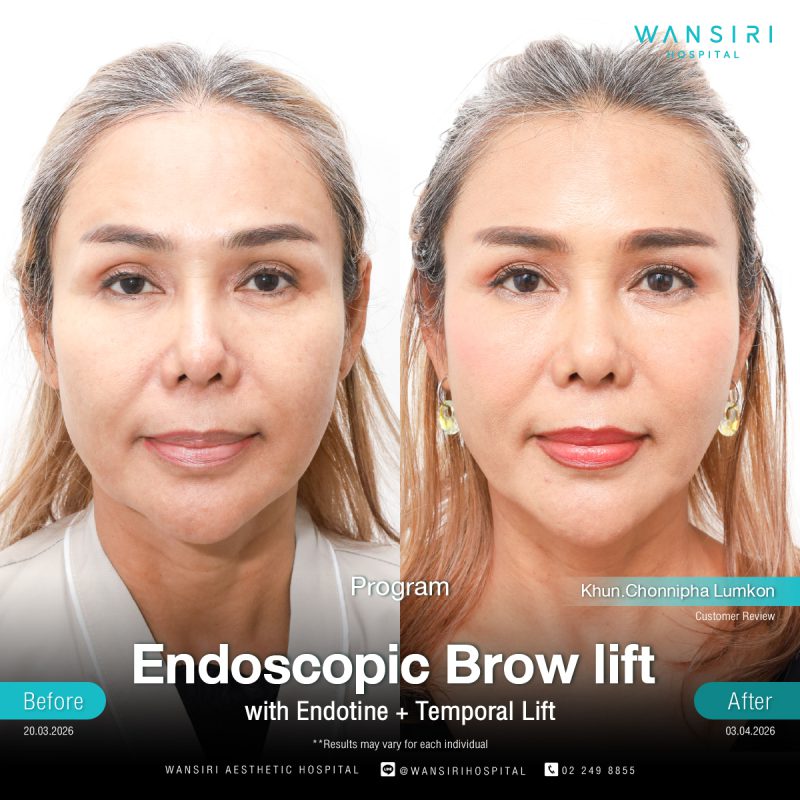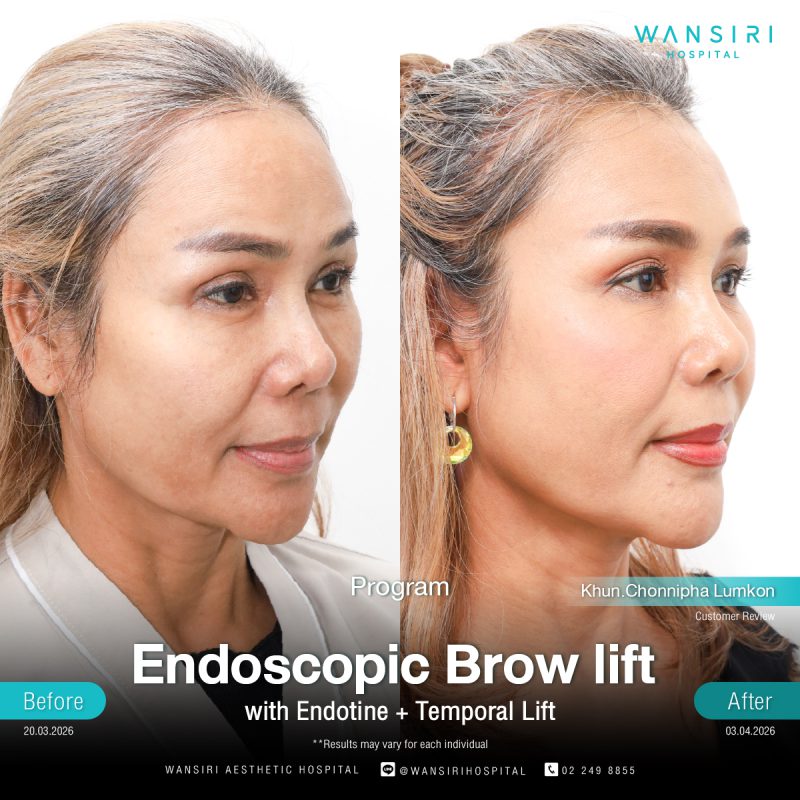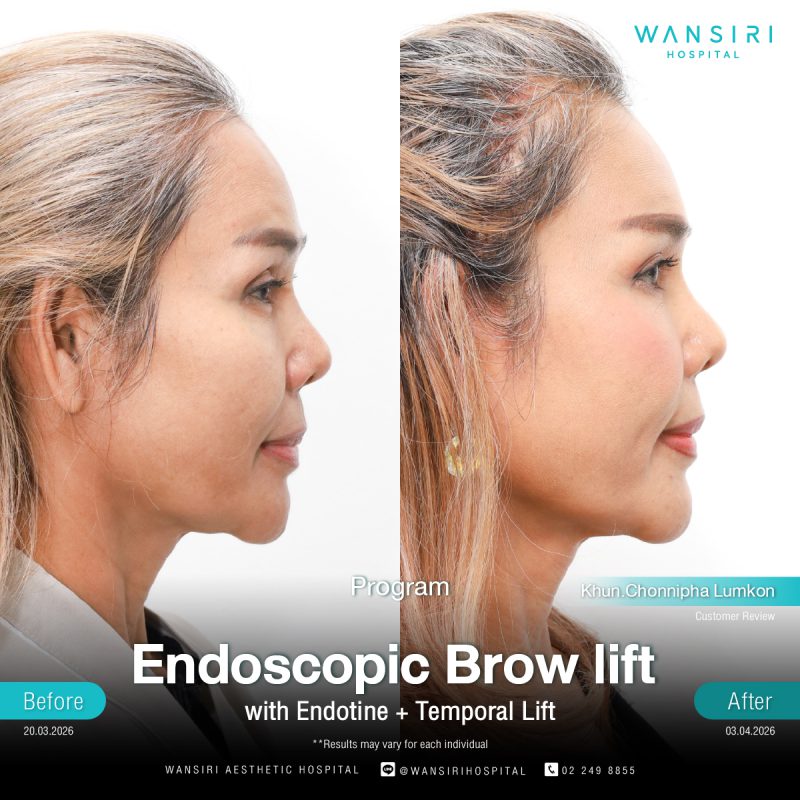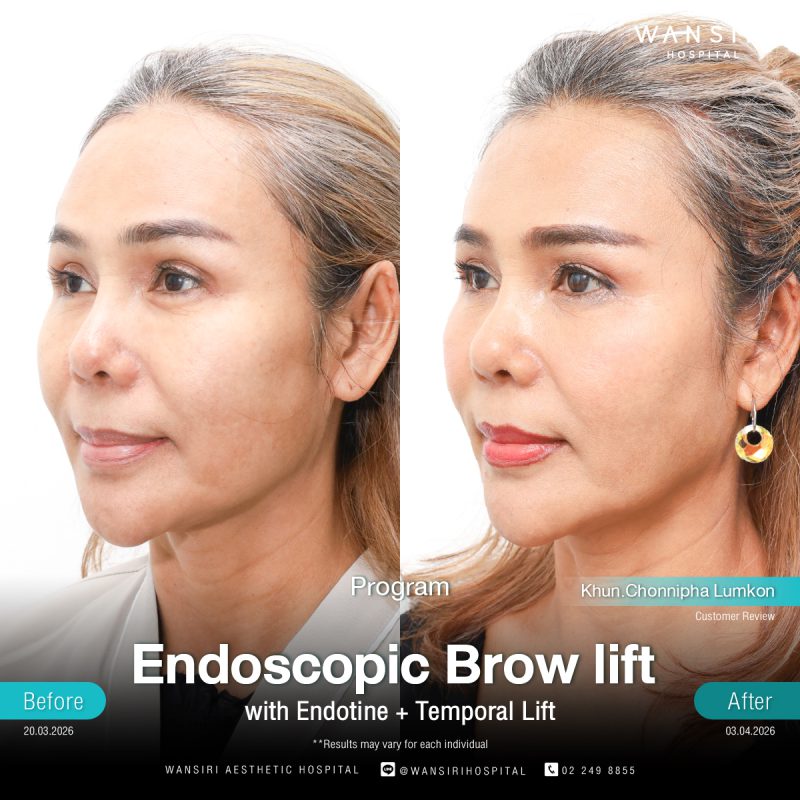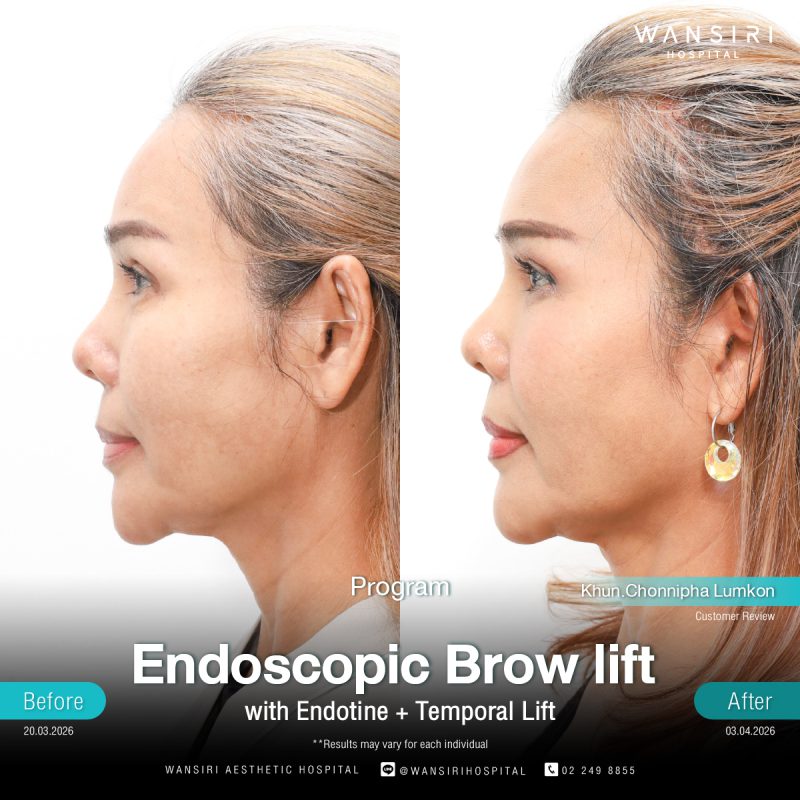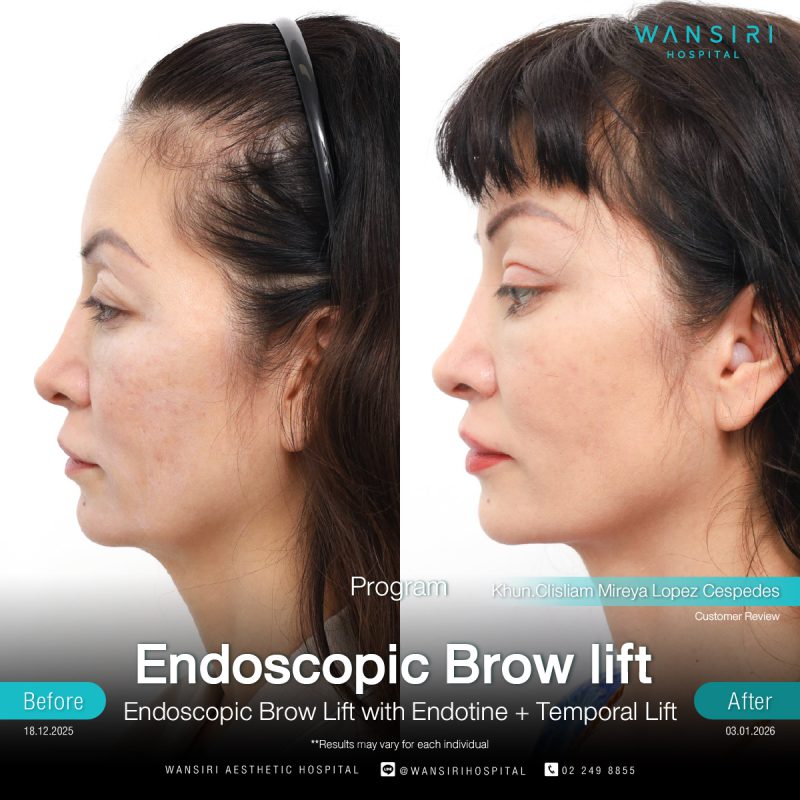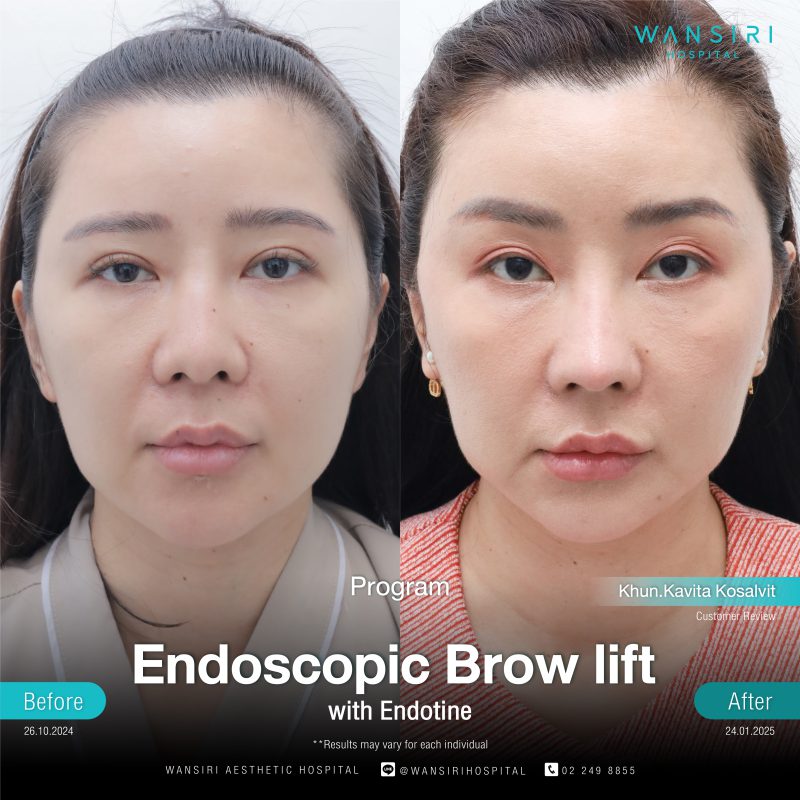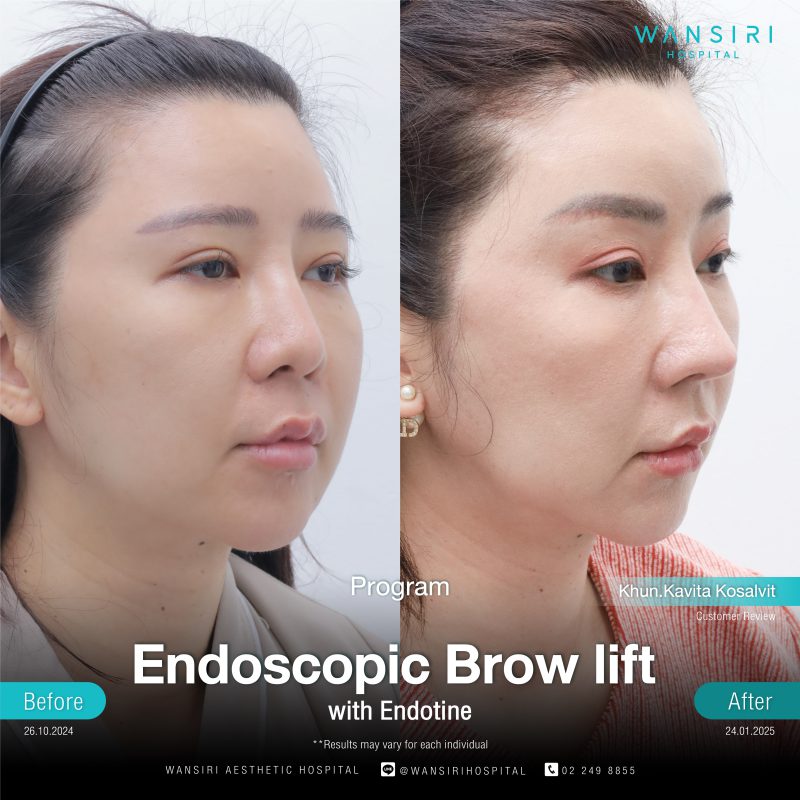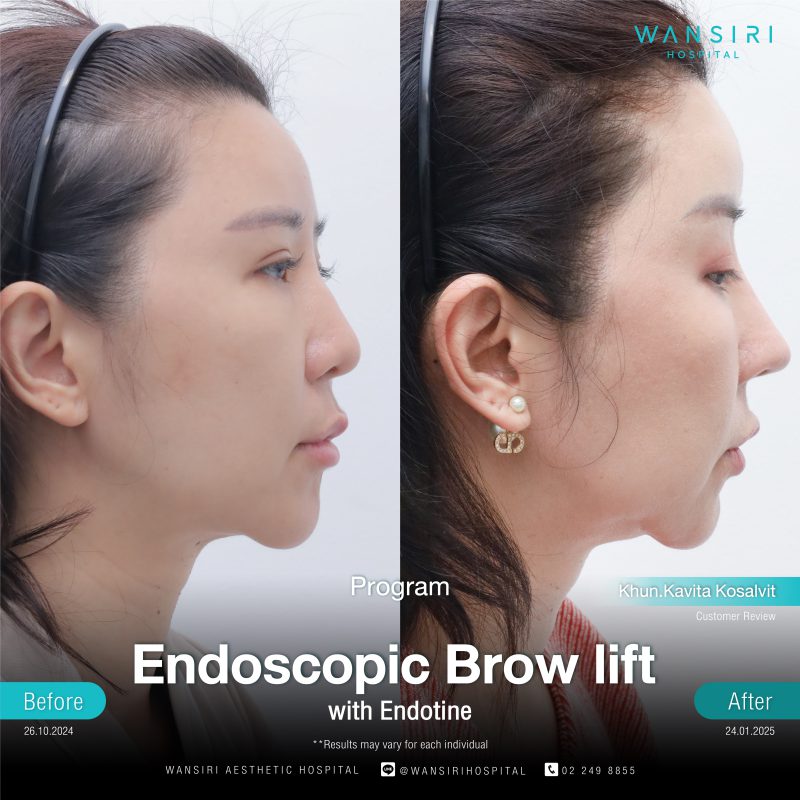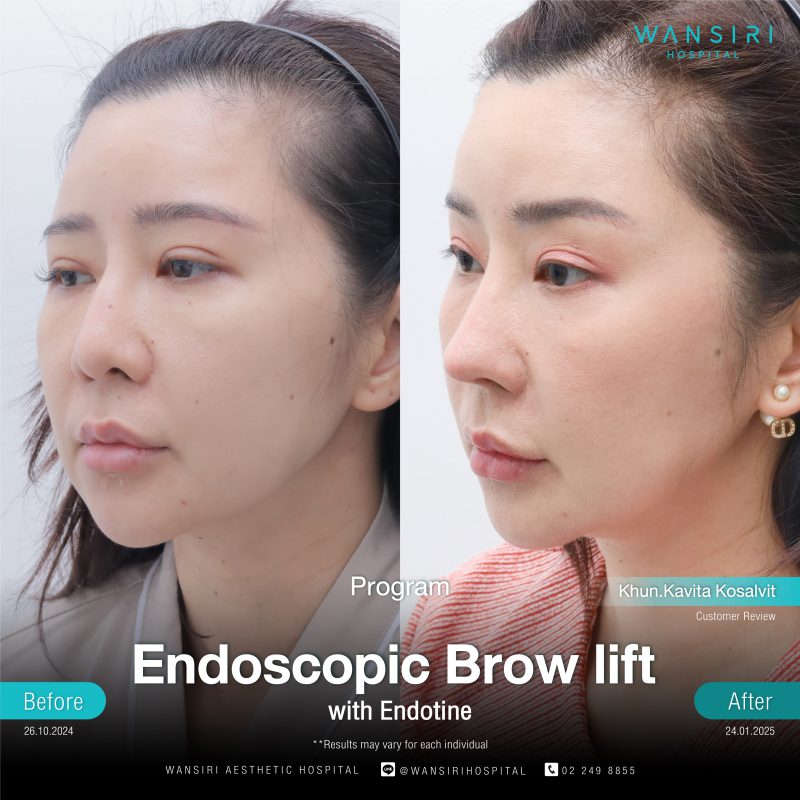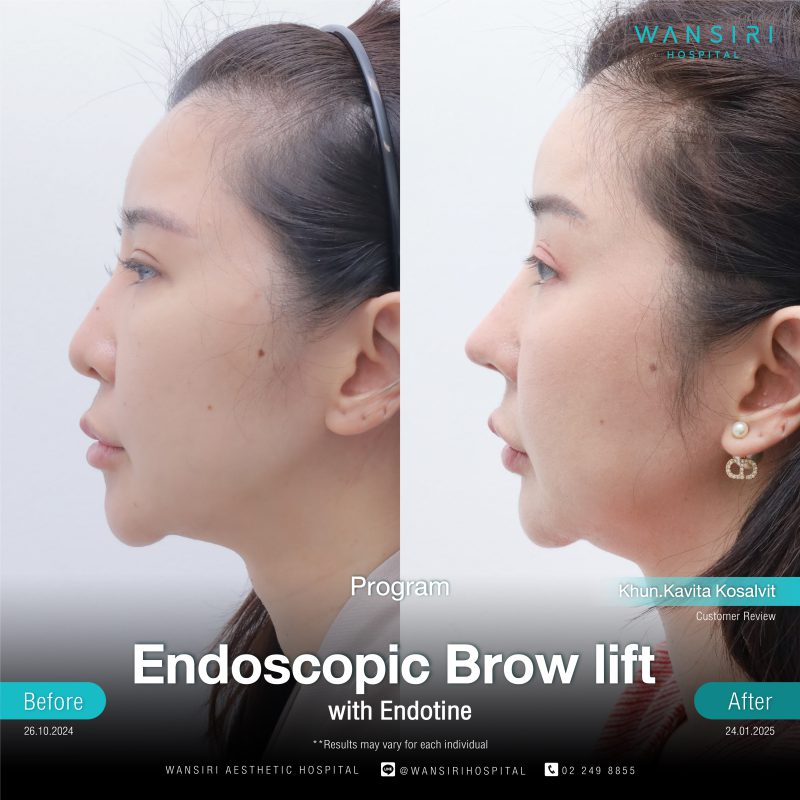

























Endoscopic Brow Lift in Bangkok
Natural Upper-Face Rejuvenation with an Endoscopic Approach

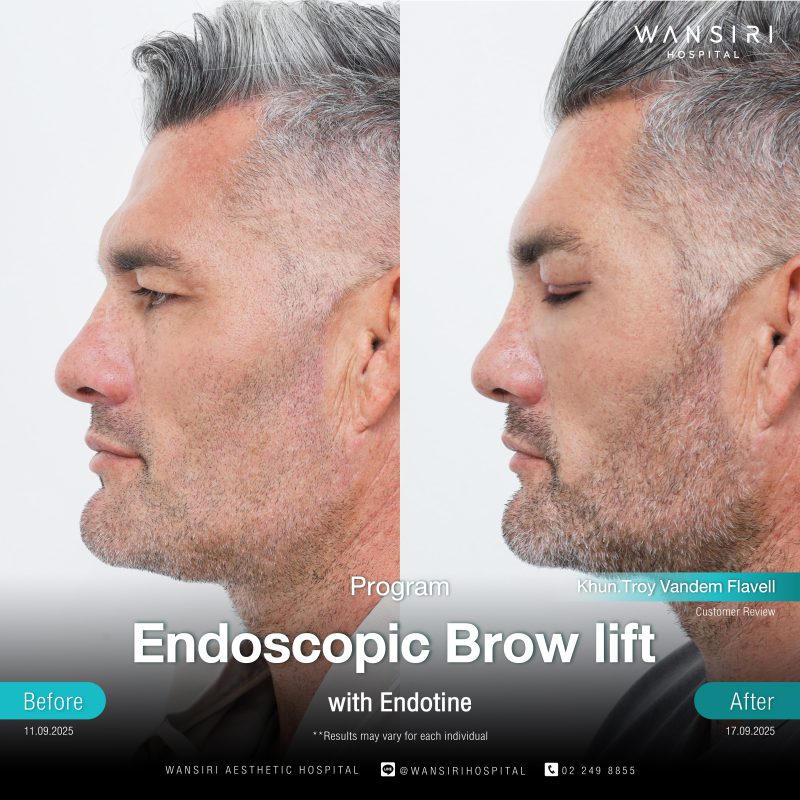
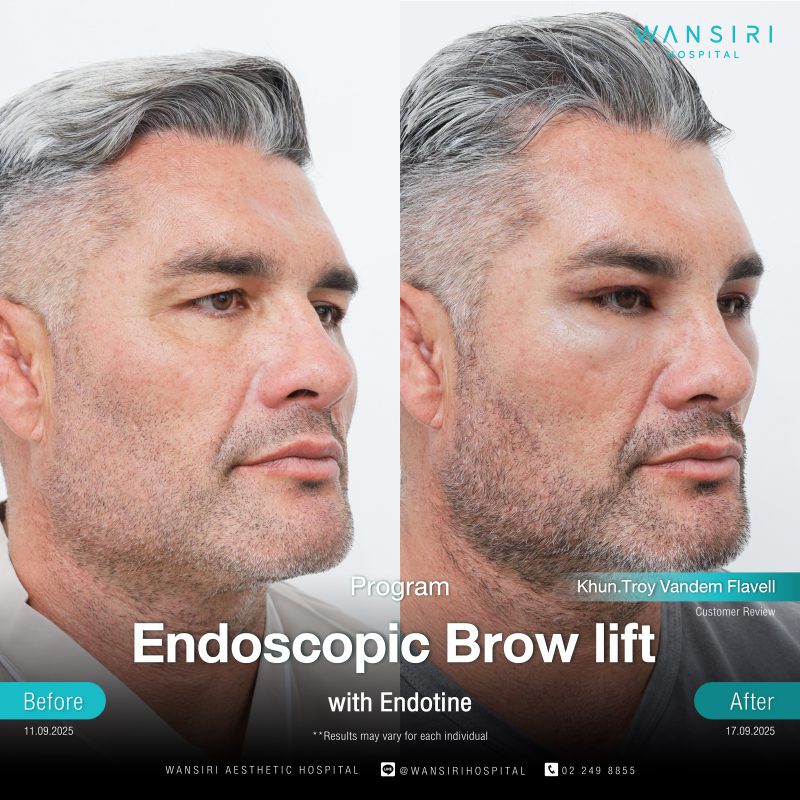
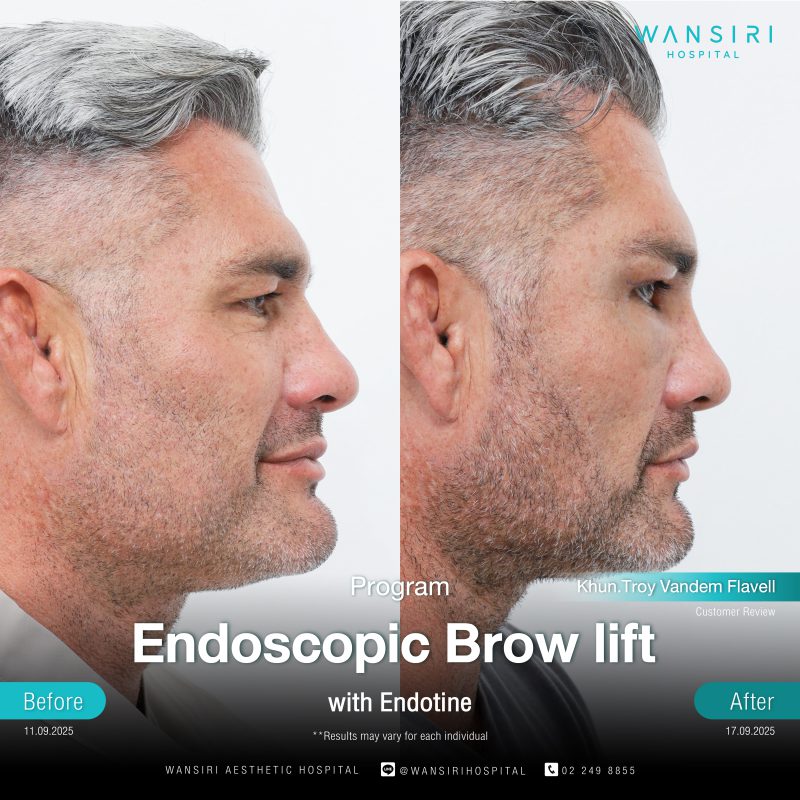
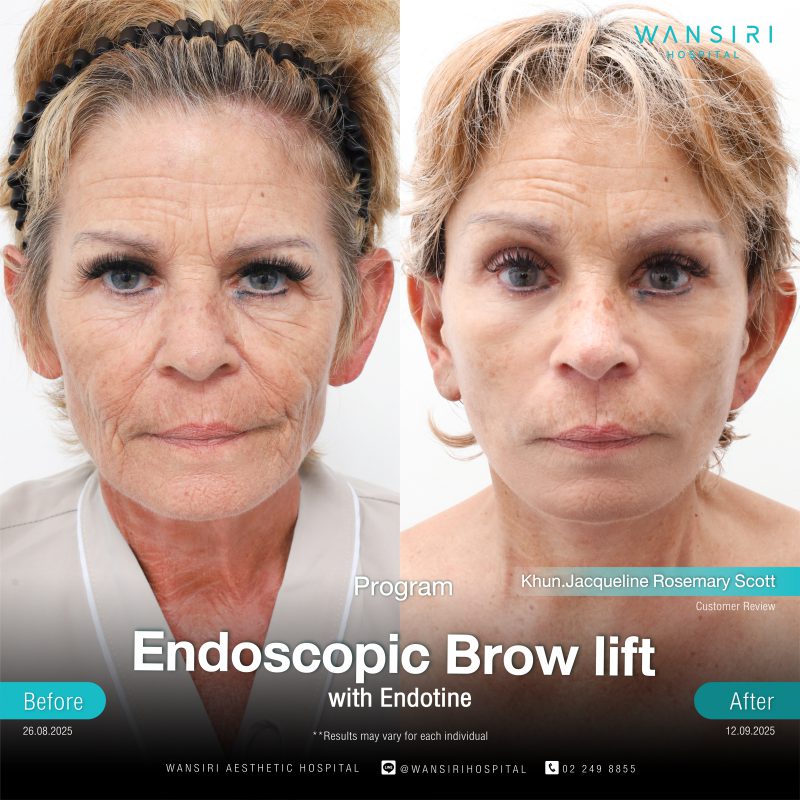
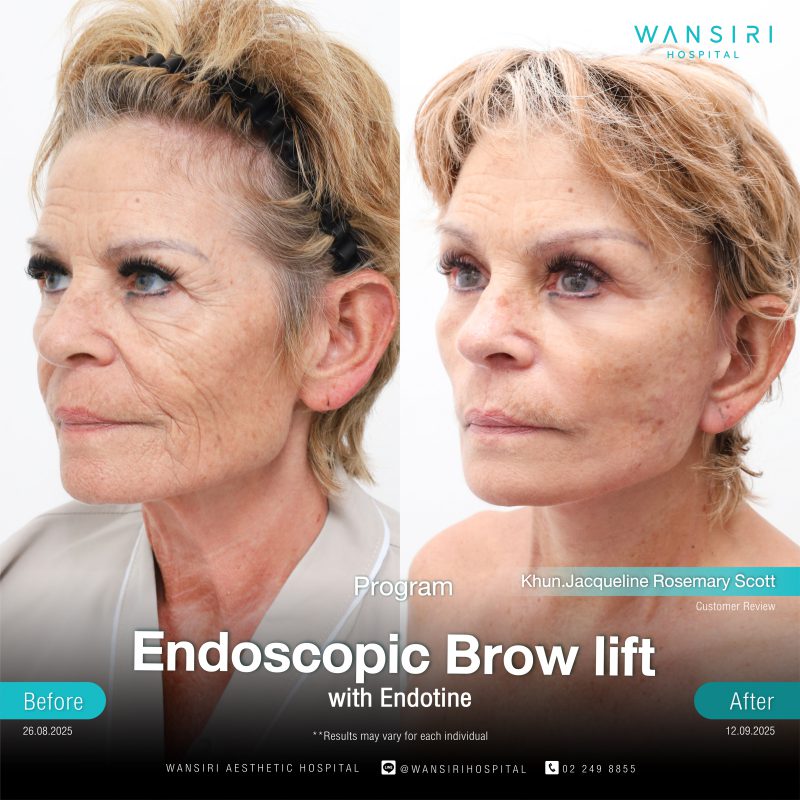
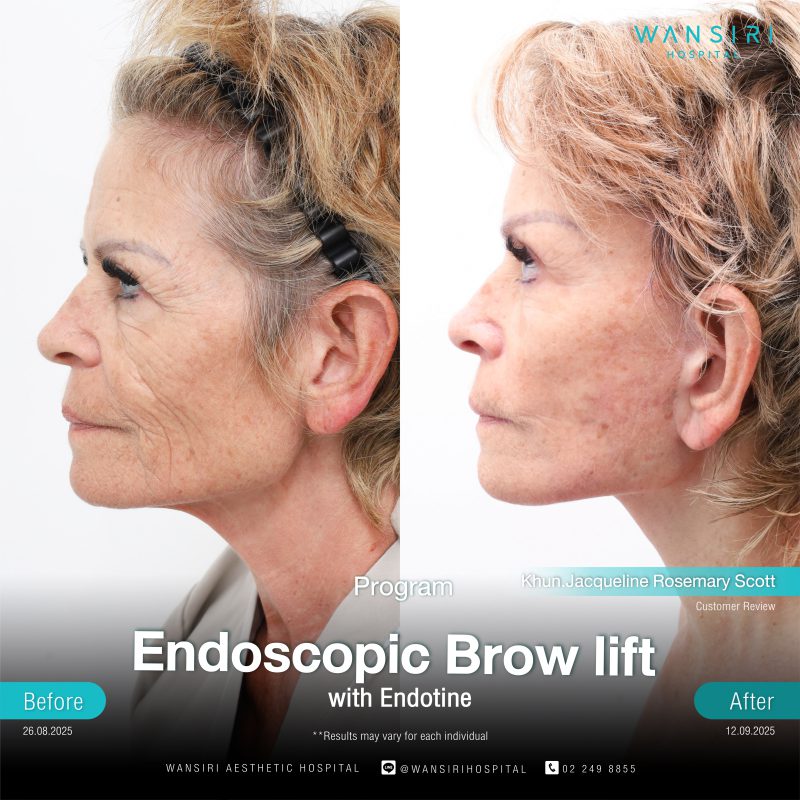
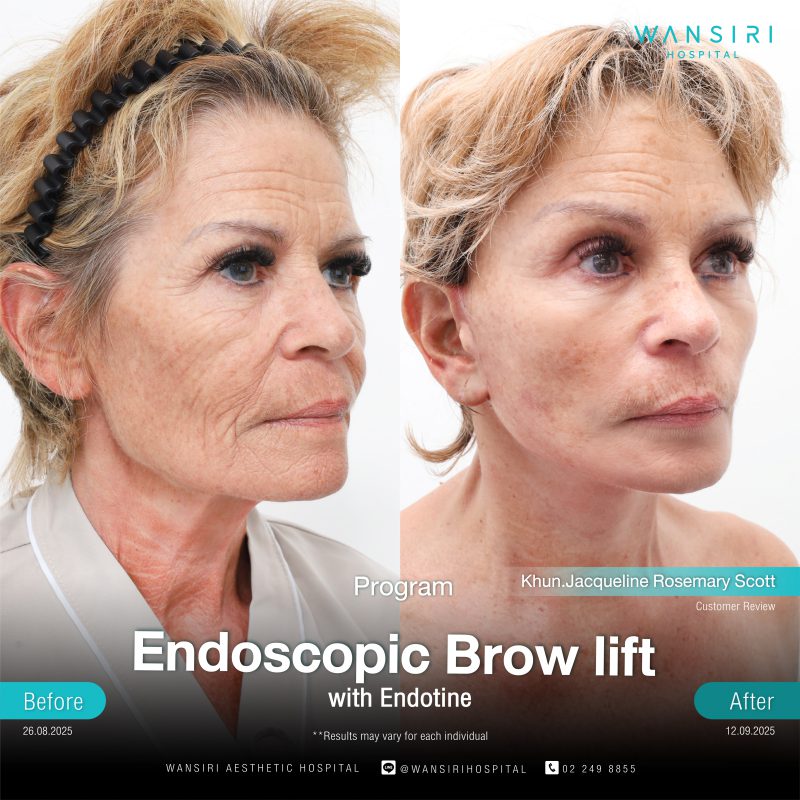
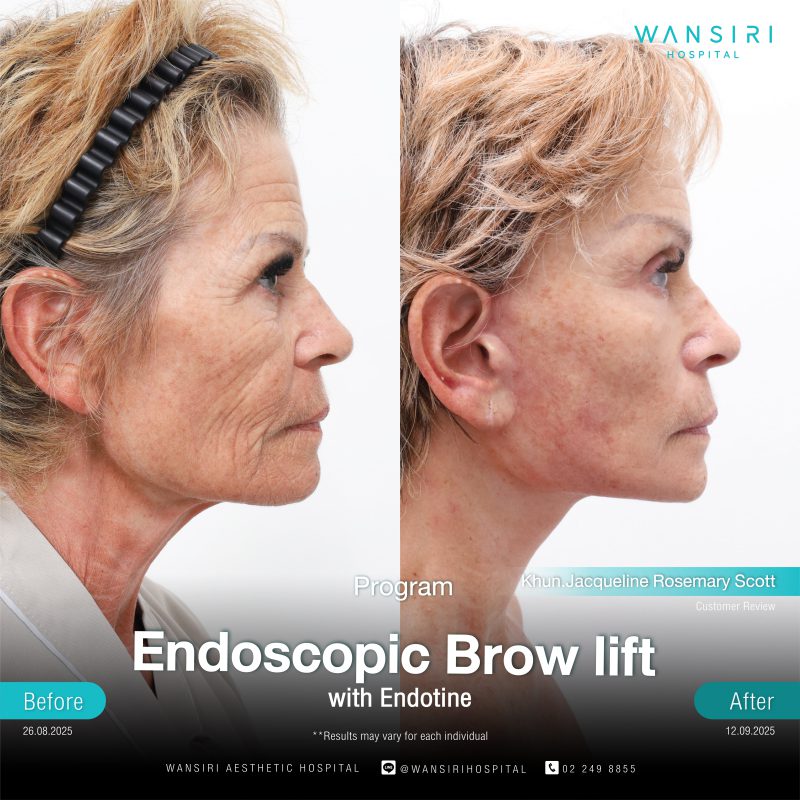
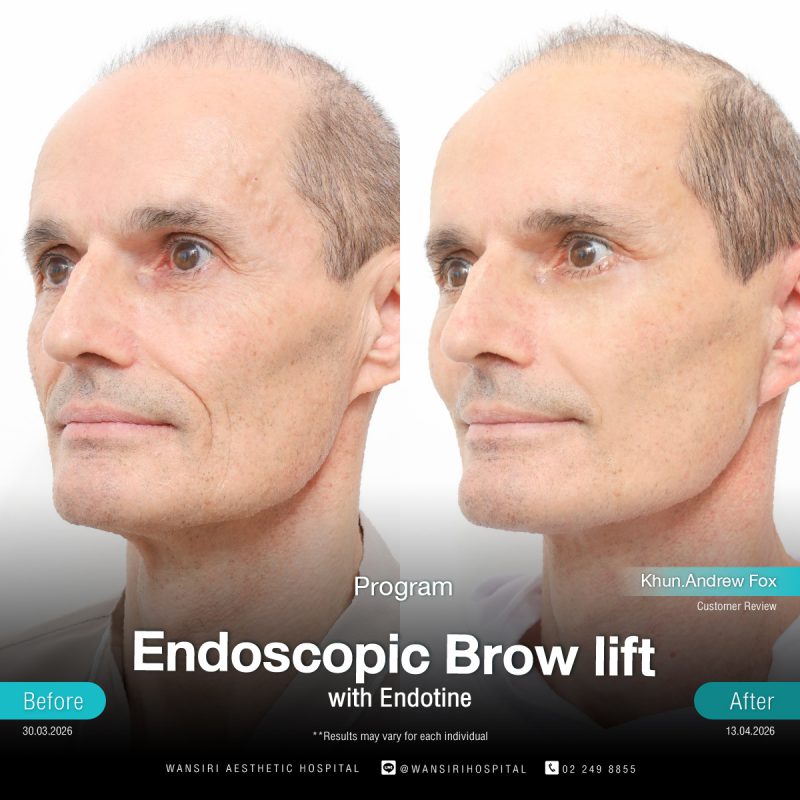
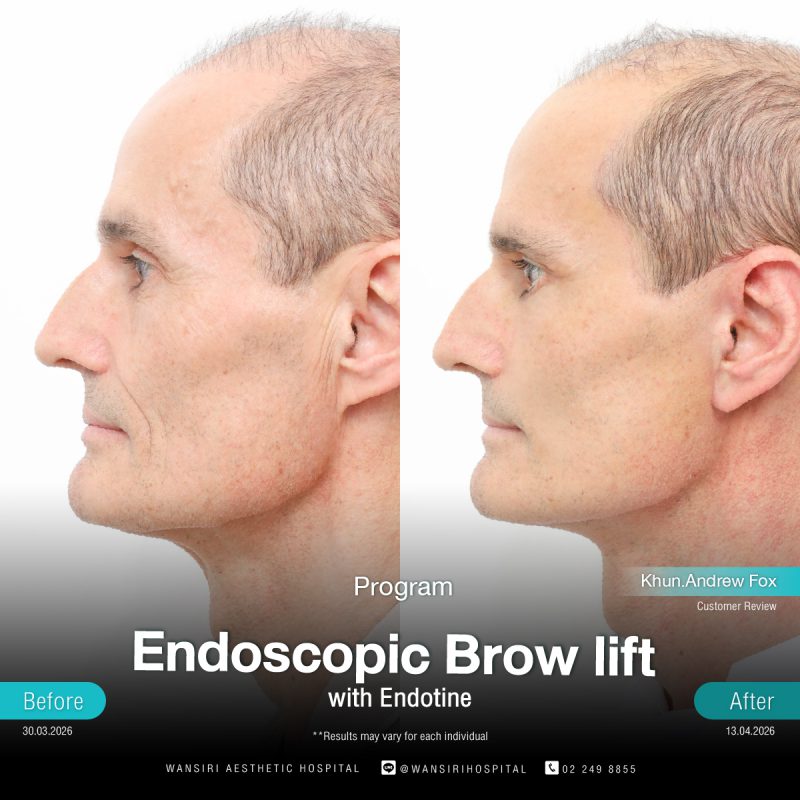
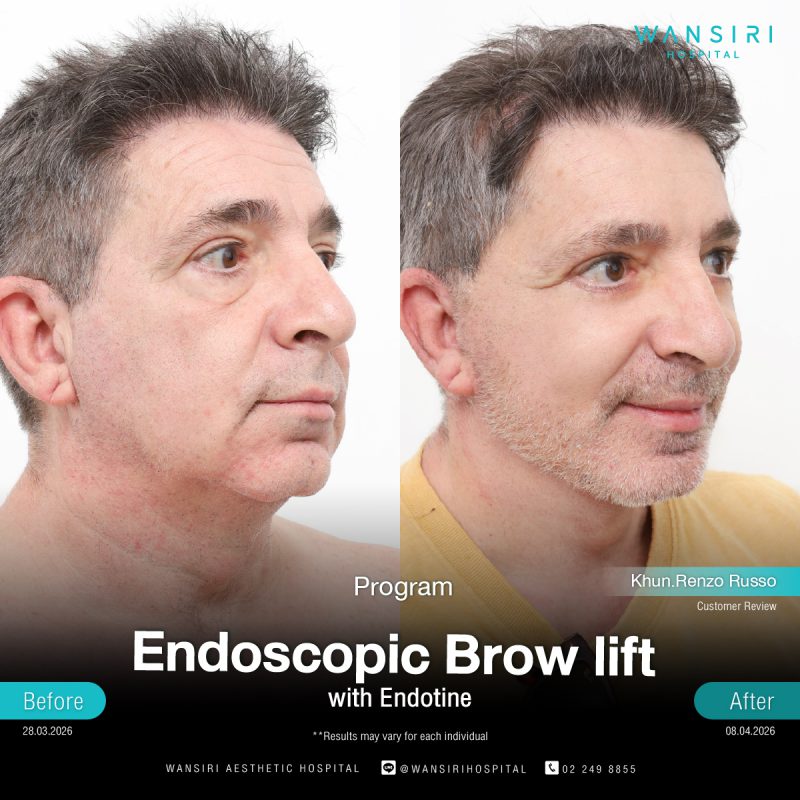
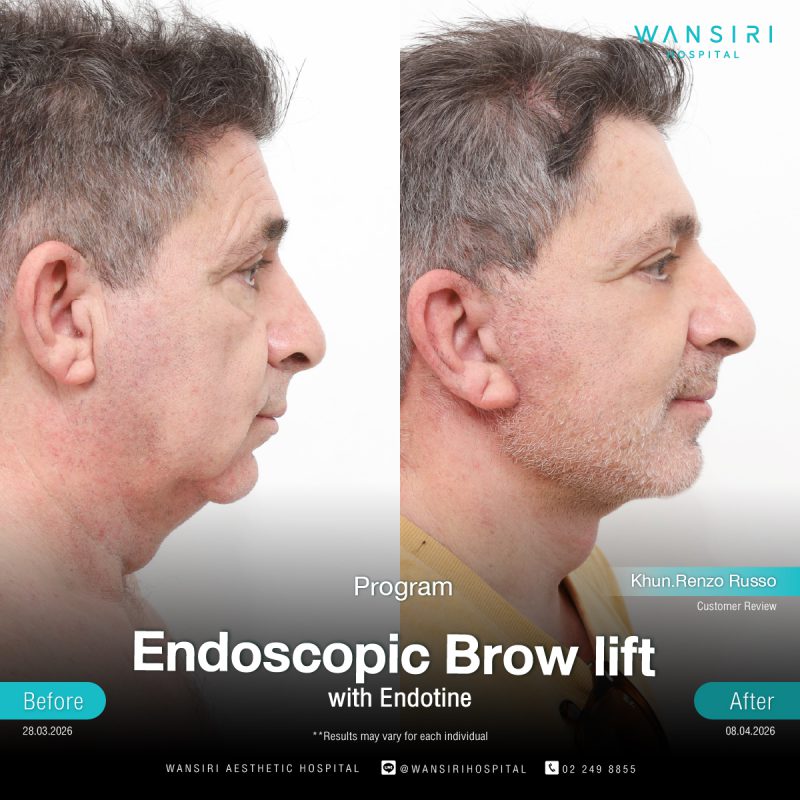
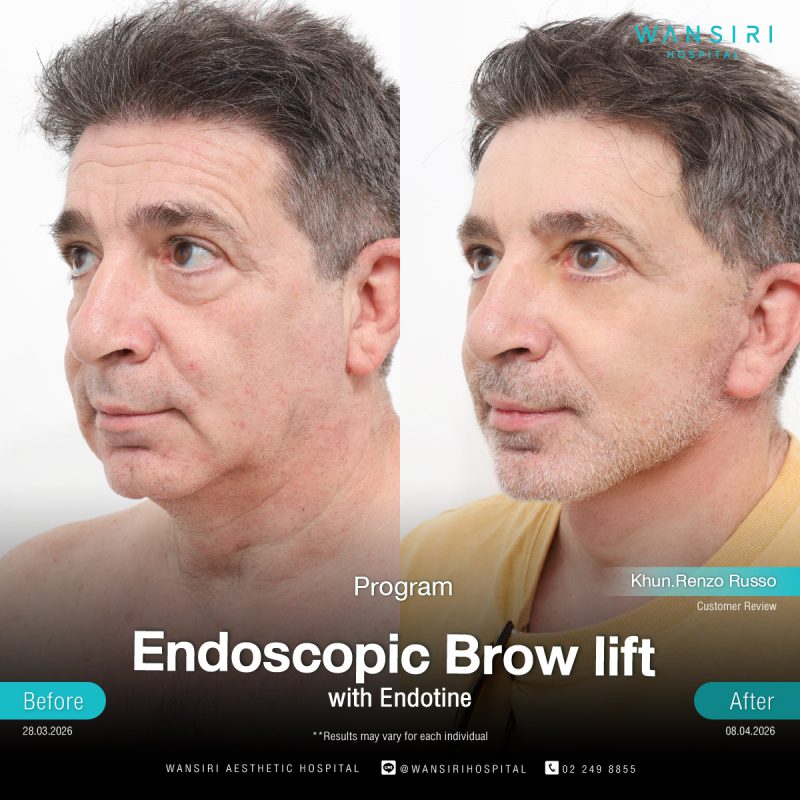
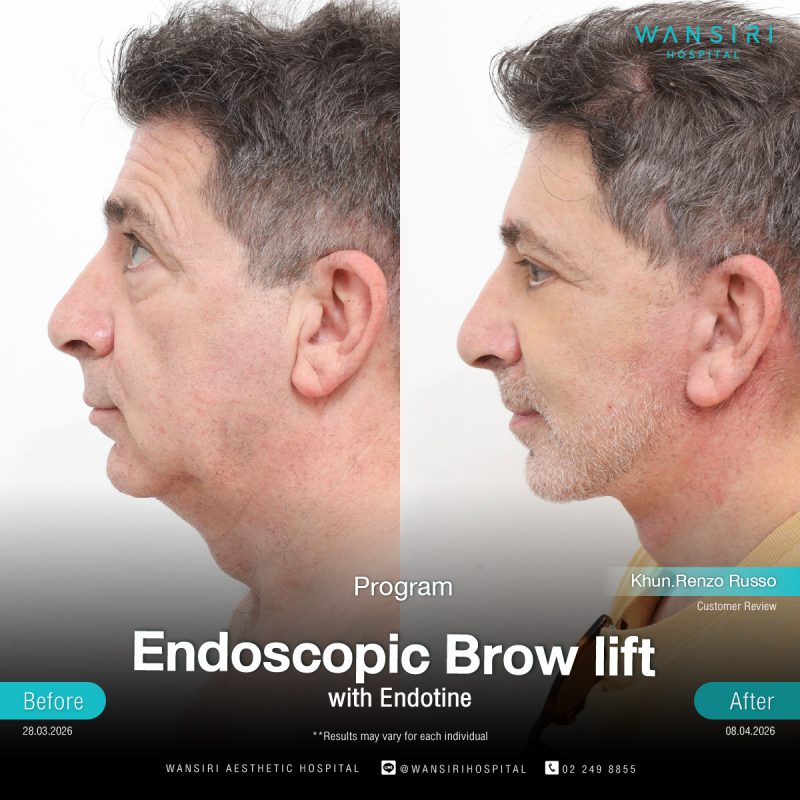
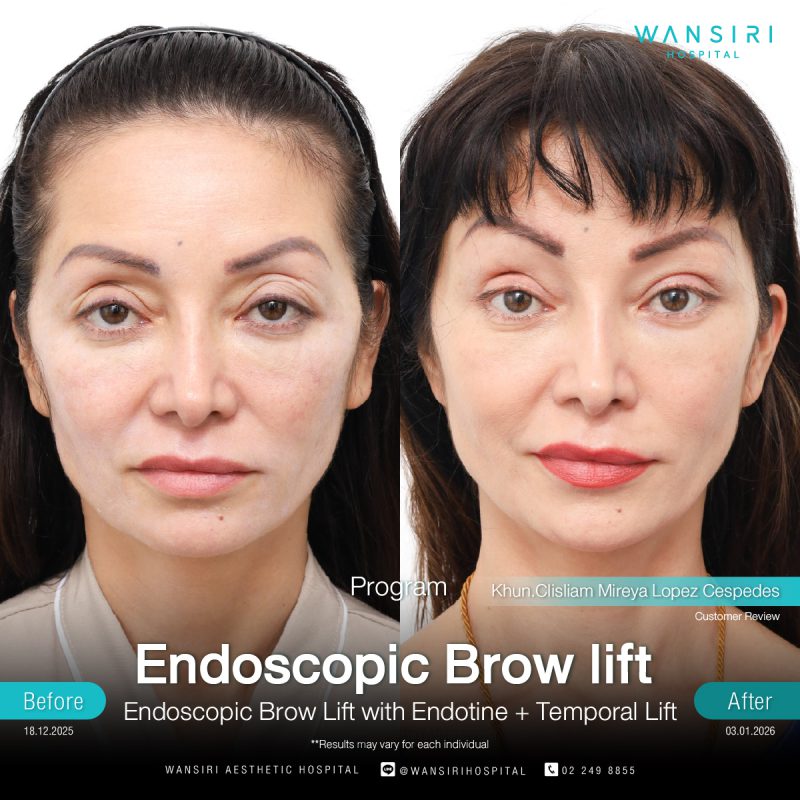
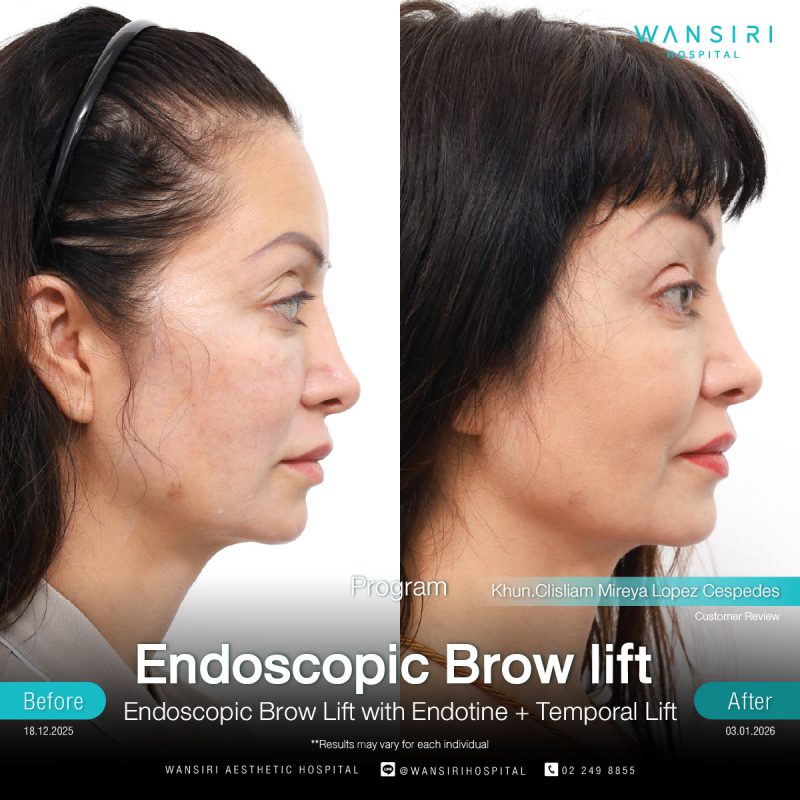
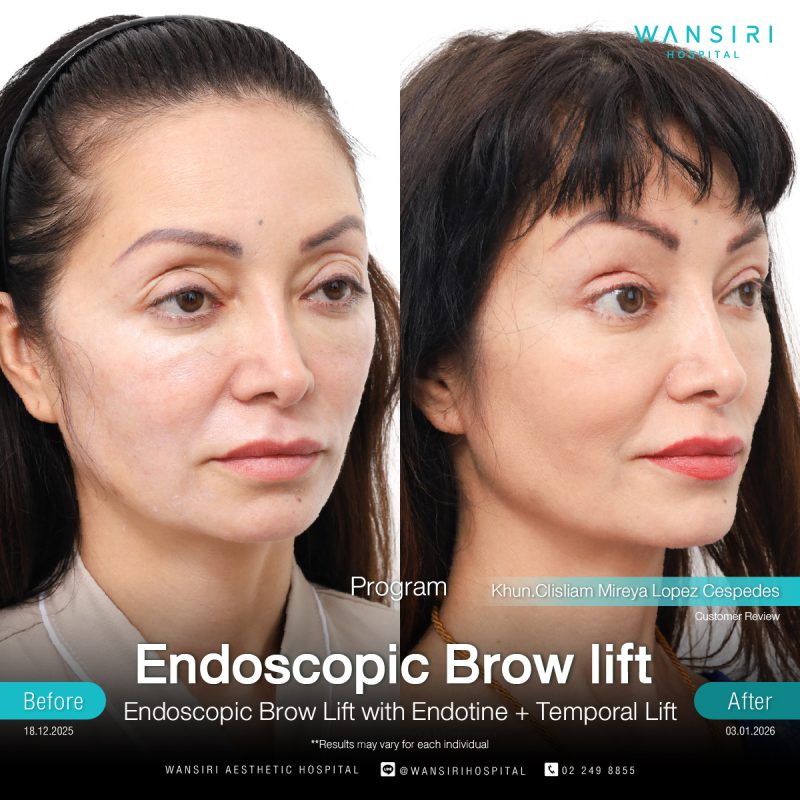
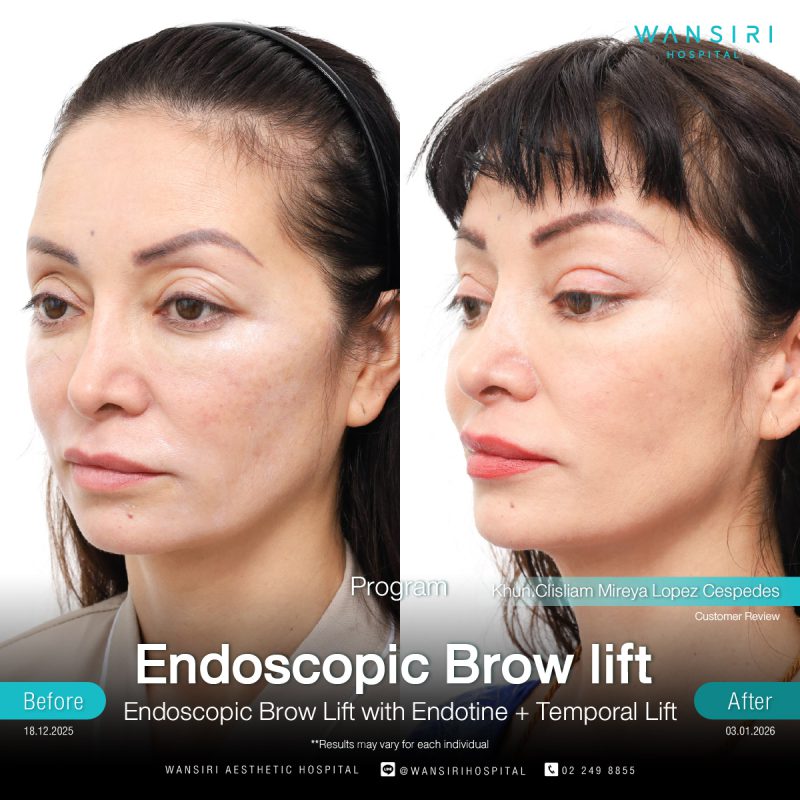
An Endoscopic Brow Lift is a surgical procedure designed to reposition descended eyebrows and forehead tissues through relatively small incisions hidden within or near the hairline.
Unlike treatments that focus only on the skin, an Endoscopic Brow Lift works with the deeper tissues responsible for brow position. The aim is not simply to raise the eyebrows, but to restore a more balanced relationship between the brows, forehead, upper eyelids, and eyes.
At Wansiri Hospital in Bangkok, Thailand, Endoscopic Brow Lift surgery is planned individually according to each patient’s facial anatomy, brow position, forehead height, hairline, upper eyelid relationship, facial symmetry, and desired degree of change.
The goal is a refreshed and naturally proportioned upper face—not an excessively elevated or surprised appearance.
What Is an Endoscopic Brow Lift?
An Endoscopic Brow Lift, also known as an endoscopic forehead lift, is a surgical technique used to reposition descended brow and forehead tissues.
During the procedure, several small incisions are generally made within or near the hair-bearing scalp. A small endoscopic camera allows the surgeon to visualize the underlying anatomical structures while carefully releasing and repositioning the tissues.
Compared with some traditional open brow-lift techniques, the endoscopic approach generally requires shorter scalp incisions.
However, an Endoscopic Brow Lift is not necessarily the best technique for every patient. The appropriate surgical approach depends on the degree of brow descent, forehead anatomy, hairline, tissue quality, previous procedures, and individual treatment goals.


If you are experiencing :

Have wrinkles around your forehead and between your eyebrows
Have excess skin on your eyelids
Are not satisfied with results from getting Bo or Filling Substance
Endotine Technique is the procedure for you, right here, at Wansiri Hospital
What Can an Endoscopic Brow Lift Improve?
An Endoscopic Brow Lift may be considered for patients concerned about:
- Descended or low-positioned eyebrows
- Lateral brow drooping
- Heaviness around the outer upper eyelids
- A tired-looking upper face
- Brow asymmetry in selected cases
- Forehead tissue descent
- Age-related changes affecting the upper third of the face
One important part of consultation is determining where the heaviness actually originates.
For example, upper-eye heaviness may be caused by brow descent, excess upper eyelid skin, or a combination of both. Correct diagnosis is therefore important before selecting surgery.
How Does an Endoscopic Brow Lift Work?
The basic principles of an Endoscopic Brow Lift are visualization, tissue release, repositioning, and fixation.
Through small scalp incisions, the endoscope provides visualization of the surgical area. The surgeon works within the appropriate anatomical plane while identifying and protecting important structures.
The descended brow and forehead tissues are then carefully released so that they can be repositioned according to the surgical plan.
Once the desired position has been achieved, the tissues are stabilized while healing takes place.
Different fixation techniques can be used. The appropriate method depends on the surgeon’s technique, the patient’s anatomy, and the degree of repositioning required.
Endoscopic Brow Lift with Endotine
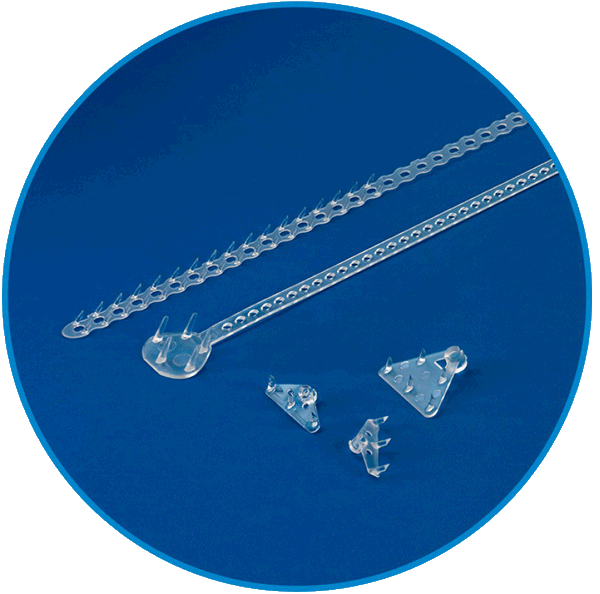
Endotine is an absorbable fixation system that may be used during an Endoscopic Brow Lift.
The device is designed with multiple fixation points that help distribute elevated tissue while the tissues heal in their new position. The fixation material is gradually absorbed by the body over time.
It is important to understand that Endotine is a fixation method—not the entire brow-lift procedure.
Successful brow rejuvenation depends on several factors, including:
- Accurate facial assessment
- Appropriate tissue release
- Knowledge of forehead and temporal anatomy
- Brow repositioning
- Fixation strategy
- Facial proportions
- Individual healing
Not every patient requires the same fixation technique. The surgeon should determine the appropriate method after evaluating the patient’s anatomy.
Endoscopic Brow Lift vs. Traditional Brow Lift
Both procedures are designed to improve brow position, but they use different surgical approaches.
Endoscopic Brow Lift
An Endoscopic Brow Lift generally uses several relatively small scalp incisions and an endoscopic camera to visualize the underlying anatomy.
It may be considered for appropriately selected patients with brow descent who would benefit from tissue repositioning without a longer scalp incision.
Traditional or Open Brow Lift
Traditional brow-lifting procedures use different incision patterns and may provide advantages in patients with particular forehead characteristics, significant tissue excess, certain hairline considerations, or more advanced brow descent.
Which technique is better?
There is no single brow-lift technique that is best for every patient.
The appropriate procedure depends on:
Brow position
Forehead length
Hairline
Degree of tissue descent
Skin and soft-tissue characteristics
Previous surgery
Facial proportions
Desired outcome
The procedure should therefore be selected according to anatomy rather than simply according to the name of the technique.
Who Is a Good Candidate for an Endoscopic Brow Lift?
A patient may be considered for an Endoscopic Brow Lift when brow descent contributes to heaviness or aging changes around the upper face.
Potential candidates may have:
- Low or descended eyebrows
- Lateral brow descent
- Upper-eye heaviness related to brow position
- Age-related forehead tissue descent
- Reasonable skin and tissue quality
- Realistic expectations
- Appropriate general health for elective surgery
Age alone does not determine suitability.
Some younger patients naturally have relatively low brow positions, while others develop brow descent gradually with aging.
A detailed facial assessment is therefore more important than using a specific age as the indication for surgery.
Brow Lift or Upper Eyelid Surgery: Which Do I Need?
This is an important distinction in upper-face rejuvenation.
Heavy or hooded upper eyelids do not always originate from excess eyelid skin.
In some patients, the eyebrow has descended and contributes significantly to tissue heaviness above the eye. Other patients primarily have excess upper eyelid skin. Some have both conditions.
During consultation, the surgeon should assess:
- Brow height
- Brow shape
- Lateral brow position
- Upper eyelid skin
- Eyelid crease
- Forehead muscle activity
- Forehead length
- Hairline
- Facial symmetry
- Previous eyelid or brow procedures
Depending on the findings, the surgeon may recommend an Endoscopic Brow Lift, upper blepharoplasty, or a combination of procedures.

Can an Endoscopic Brow Lift Improve Hooded Eyes?
It can improve a hooded appearance in selected patients when brow descent contributes to upper-eye heaviness.
Repositioning the brow may reduce some of the tissue pressure above the upper eyelid, particularly around the outer eye.
However, an Endoscopic Brow Lift does not remove true excess eyelid skin.
Patients whose hooded appearance is primarily caused by excess upper eyelid skin may benefit more from upper blepharoplasty.
When both brow descent and eyelid skin excess are present, combination surgery may be considered.
Can an Endoscopic Brow Lift Make the Eyes Look More Open?
Potentially, yes—but the effect occurs indirectly.
An Endoscopic Brow Lift does not enlarge the anatomical size of the eyes.
Instead, repositioning a descended eyebrow may reduce heaviness around the upper eyelid and create a more open, refreshed appearance.
The amount of change depends on the patient’s original brow position, eyelid anatomy, and surgical plan.
The objective should generally be improved facial balance rather than creating an artificially enlarged eye appearance.
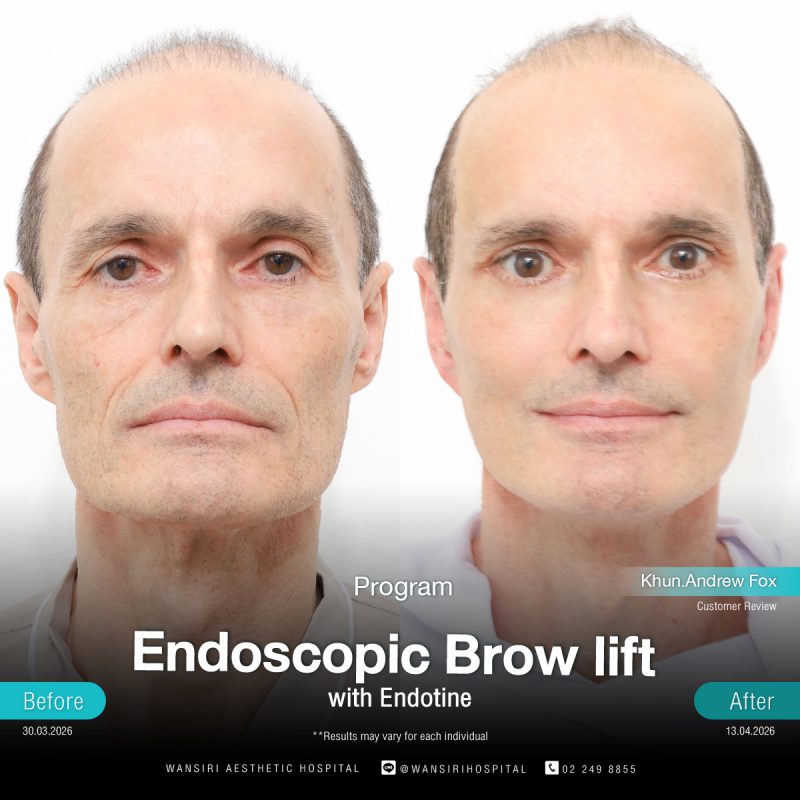
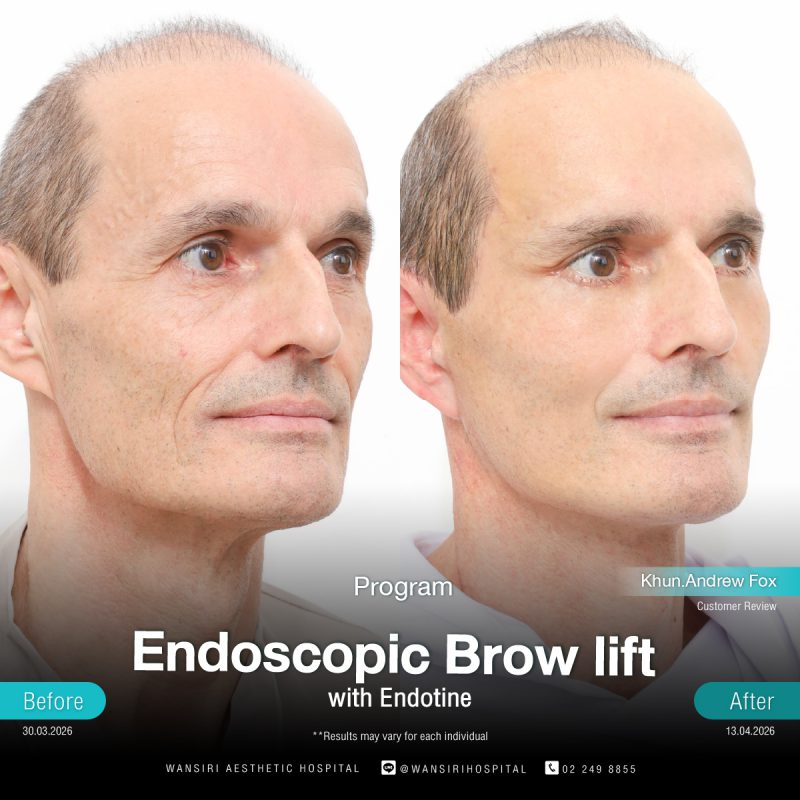
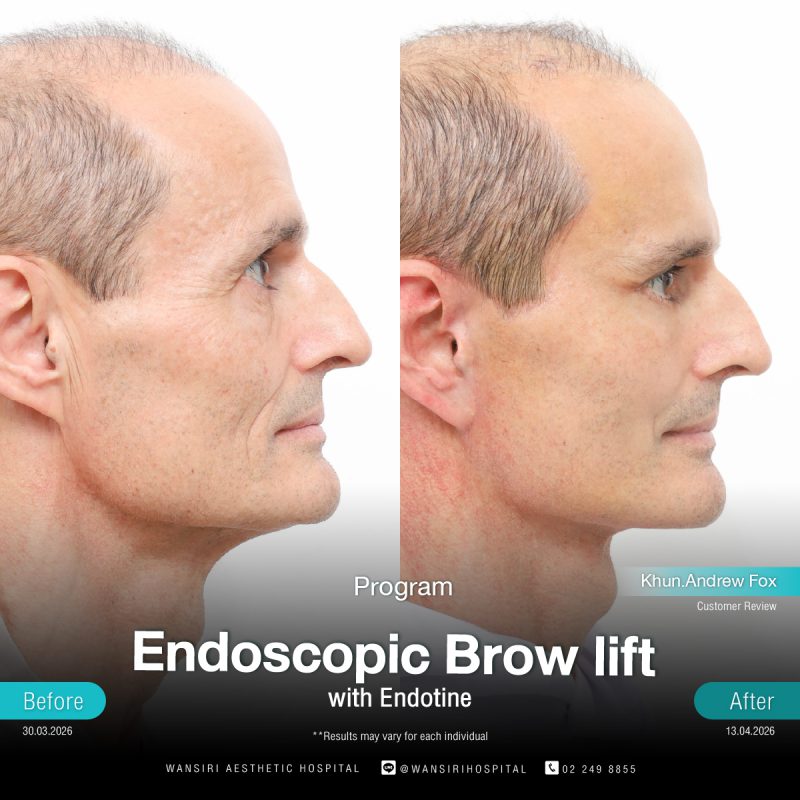
What Results Can You Expect from an Endoscopic Brow Lift?
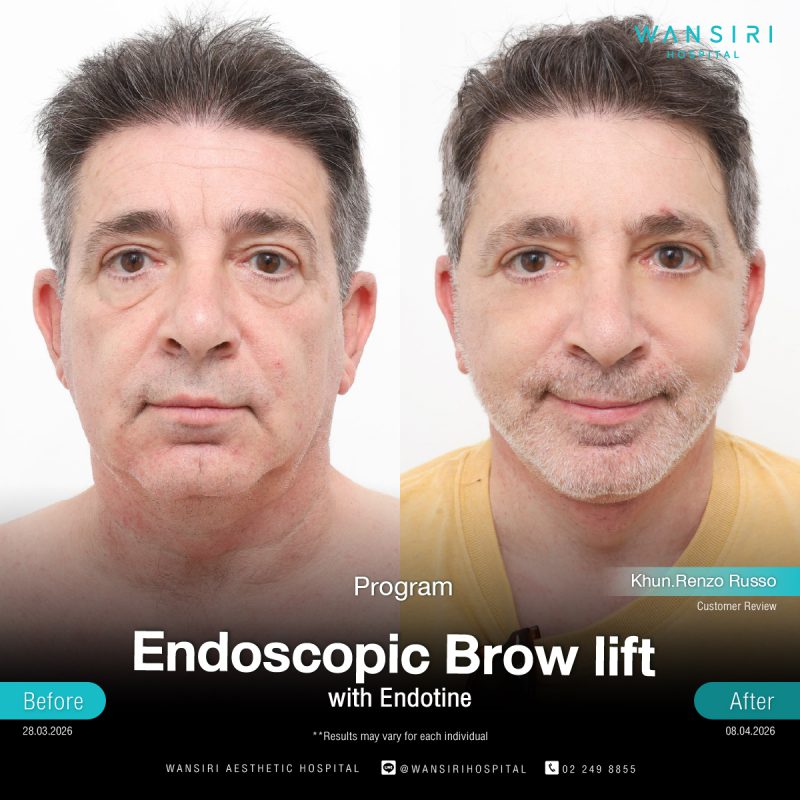
The goal of an Endoscopic Brow Lift is generally controlled repositioning rather than dramatic elevation.
Depending on individual anatomy, potential improvements may include:
- A more balanced eyebrow position
- Improvement in lateral brow descent
- Reduced upper-eye heaviness related to brow position
- A more refreshed upper-face appearance
- Improved relationship between the brows and upper eyelids
- Better overall upper-face proportions
Results vary between individuals.
Factors affecting the outcome include anatomy, tissue quality, surgical technique, fixation, healing response, lifestyle, and the natural aging process.
Will an Endoscopic Brow Lift Look Natural?
Natural-looking results depend on more than how high the eyebrow is positioned.
The brow should remain proportionate to the patient’s:
- Eyes
- Forehead
- Hairline
- Orbital anatomy
- Facial shape
- Natural expression
- Overall facial proportions
Over-elevation may produce an unnatural or surprised appearance.
For this reason, surgical planning should focus on where the brow belongs on the individual face, rather than simply attempting to maximize elevation.
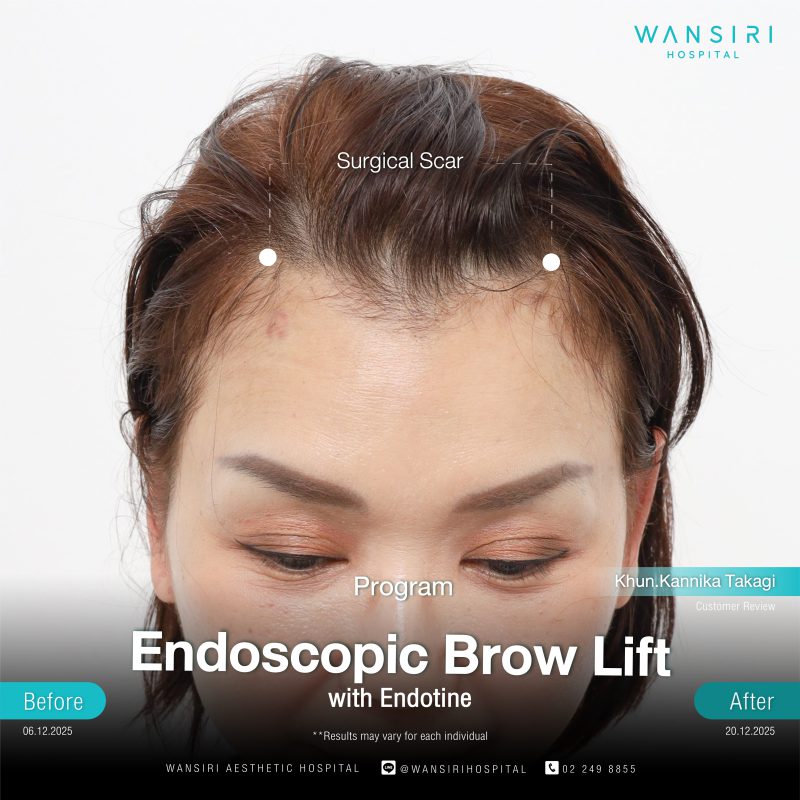
Where Are Endoscopic Brow Lift Incisions Located?
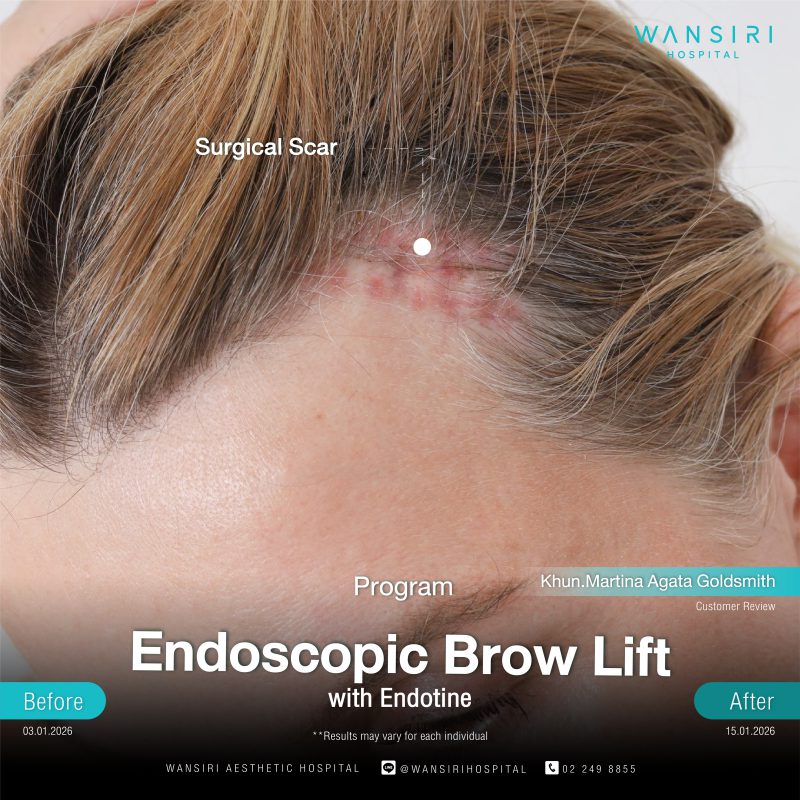
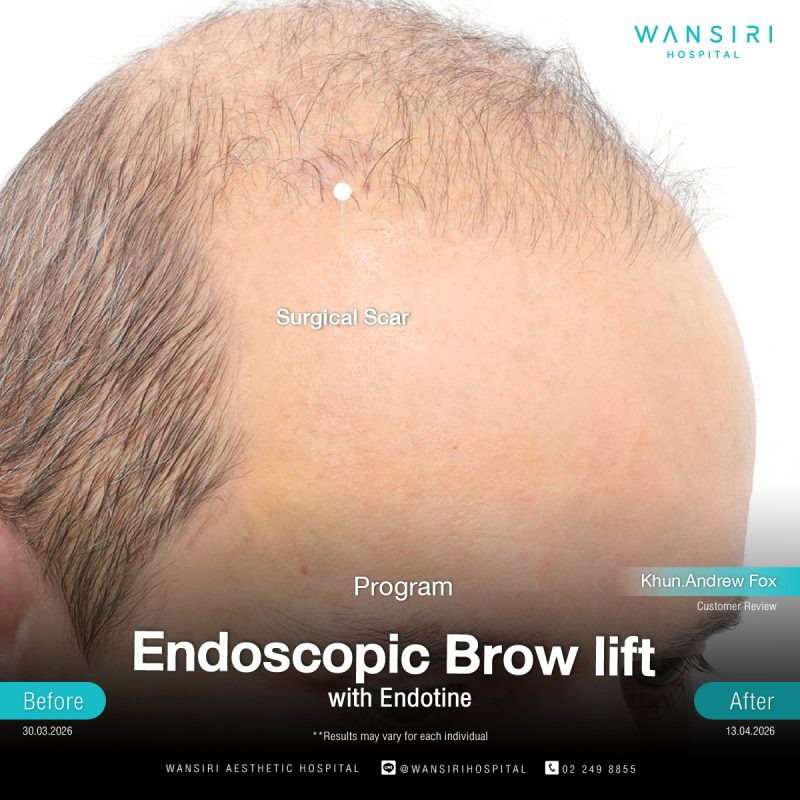
The procedure is generally performed through several relatively small incisions positioned within or near the hair-bearing scalp.
Their precise number and location depend on the surgical approach and fixation technique.
Positioning incisions within the hair-bearing area can help make scars less conspicuous as healing progresses.
However, no surgeon can guarantee invisible scars.
Scar appearance varies according to individual wound healing, genetics, hair characteristics, surgical history, and postoperative care.
Why Wansiri Hospital ?
At Wansiri Hospital, our surgeon specialists are experts in Endotine brow lift, so you can have your brows elevated to the utmost extent possible, making your face seem firmer and better. Additionally, the infections are reduced due to our standardized operating rooms, and every approach is performed by surgeon specialists. Our surgeon specialists are divided into 2 teams: anesthesiologists and surgeons.

01
We have a team of devoted and attentive medical experts, certified by The Medical Council of Thailand
02
We have modern operating rooms, fitted with state-of-the-art medical equipment approved by international standards

03
We have medical anesthesiologists/anesthetists that allow for you to have a restful, pain-free procedure

04
We have endoscopic technology, minimizing post-procedure scars and swelling

05
We have subcutaneous surgical methods that tightens your skin in the Sub-SMAS (Sub-Superficial Muscular Aponeurotic System) layer, ensuring long-lasting results

06
We are proud to present premium service standards to achieve the highest level of satisfaction
Using Endotine to lift the brows is a small surgical procedure
Whereby the plastic surgeon will make a 2.5-3 centimeter incision near the hairline to minimize any visible scarring. The plastic surgeon will then tighten the surrounding tissue using Endotine to fix the skin in place where desired. This results in an elevated look, effectively lifting brow tails, eliminating wrinkles and creating a smooth, natural appearance.
PROCEDURE
Operation Duration
2 Hours
Medication
Anesthetic
Overnight Stay
1 Night
Recovery Period
3 days after the operation
Swelling
2-3 days after the operation
Your face will get back to normal within 1-2 weeks
Follow-up Period
5-10 days (stitch removal)/ 1 month/ 3 months
Pre-Surgery Preparation
Postoperative Care
FAQS
Does undergoing the Endotine Brow Lift procedure affect my eyelids?
The brow lift may enhance the patient’s existing double/hooded eyelids, but for mono-lidded patients, the brow lift will not have any effect on the eyelids whatsoever
Will the Endotine Brow Lift make my eyes look bigger?
The procedure creates an effect that will slightly widen the patient’s eyes
If I previously had a procedure done to achieve hooded eyelids, am I still able to undergo the Endotine Brow Lift?
Yes. In fact, the endotine will highlight the effect of the hooded eyelids
Is there a possibility that my body will reject the Endotine implant?
No. The tissues will absorb the Endotine after it is subcutaneously implanted
Is there a possibility that the Endotine will become loose and won’t be able to hold the tissue in place?
The movement of the Endotine is dependent on the surgeon’s skill and expertise, but luckily at Wansiri Hospital, our medical staff are all trained and have years of expertise in this area, and it is ensured that the implant will not move
After I undergo the surgery, will my skin swell or protrude in the shape of the implant?
There may be slight swelling post-operation, but as the implant dissolves into the tissue, so will the swelling
If I’m not satisfied with my results, am I able to remove the Endotine implant before it dissolves?
The surgeon may be able to adjust the placement of the implant to achieve the patient’s desired effect, but the implant may also be removed if needed
Best Doctors for Endoscopic Brow Lift in Bangkok: How to Choose
Patients searching for the best doctors for Endoscopic Brow Lift in Bangkok should consider more than rankings, advertisements, or before-and-after photographs.
There is no medically objective way to identify one universal “best doctor” for every patient.
Instead, consider whether the surgeon has:
- Appropriate surgical qualifications
- Experience with facial and upper-face surgery
- Knowledge of endoscopic surgical techniques
- Detailed understanding of forehead, temporal, orbital, and facial nerve anatomy
- Experience evaluating the relationship between the brow and upper eyelids
- An individualized approach to brow position
- Access to appropriate hospital and anesthesia facilities
- A structured postoperative follow-up system
- A willingness to discuss limitations and potential complications
- An aesthetic approach that respects natural facial proportions
A useful consultation should address not only how much the eyebrow can be lifted, but also where the eyebrow should be positioned for the patient’s individual facial anatomy.
Endoscopic Brow Lift in Bangkok at Wansiri Hospital
Patients considering an Endoscopic Brow Lift in Bangkok should receive an individual facial assessment before deciding on surgery.
At Wansiri Hospital, Bangkok, Thailand, treatment planning considers the relationship between the eyebrows, forehead, eyelids, temples, hairline, and overall facial proportions.
Assessment may include:
- Current brow position
- Medial and lateral brow characteristics
- Forehead height
- Hairline
- Upper eyelid anatomy
- Degree of brow descent
- Facial asymmetry
- Skin and soft-tissue characteristics
- Previous facial procedures
- Medical history
- Desired degree of change
The objective is to select a surgical strategy according to the patient’s anatomy rather than applying the same brow position or lifting pattern to every face.
Why Consider Wansiri Hospital for Endoscopic Brow Lift Surgery?
Brow rejuvenation should be considered within the context of the entire upper face.
At Wansiri Hospital, assessment can include the relationship between the eyebrows, forehead, eyelids, temples, and other facial structures before a treatment plan is recommended.
Depending on the patient’s anatomy, the surgeon may discuss an Endoscopic Brow Lift alone or determine whether another procedure—or a combination of procedures—would better address the underlying concern.
Surgical treatment is performed within a hospital environment with surgical, anesthesia, and postoperative care.
Treatment recommendations should ultimately be based on individual anatomy, medical suitability, and realistic surgical goals.
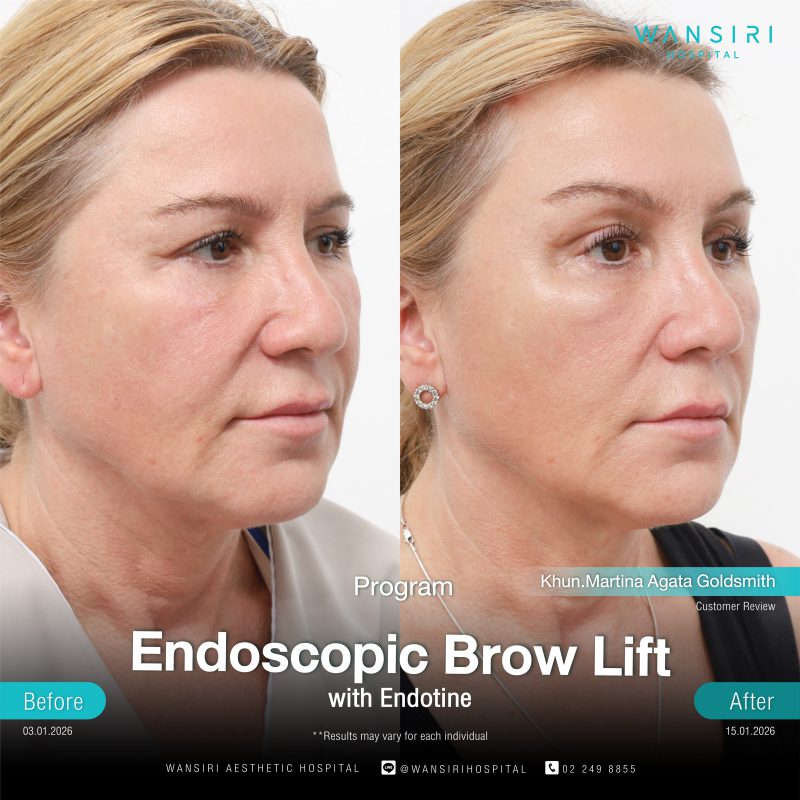
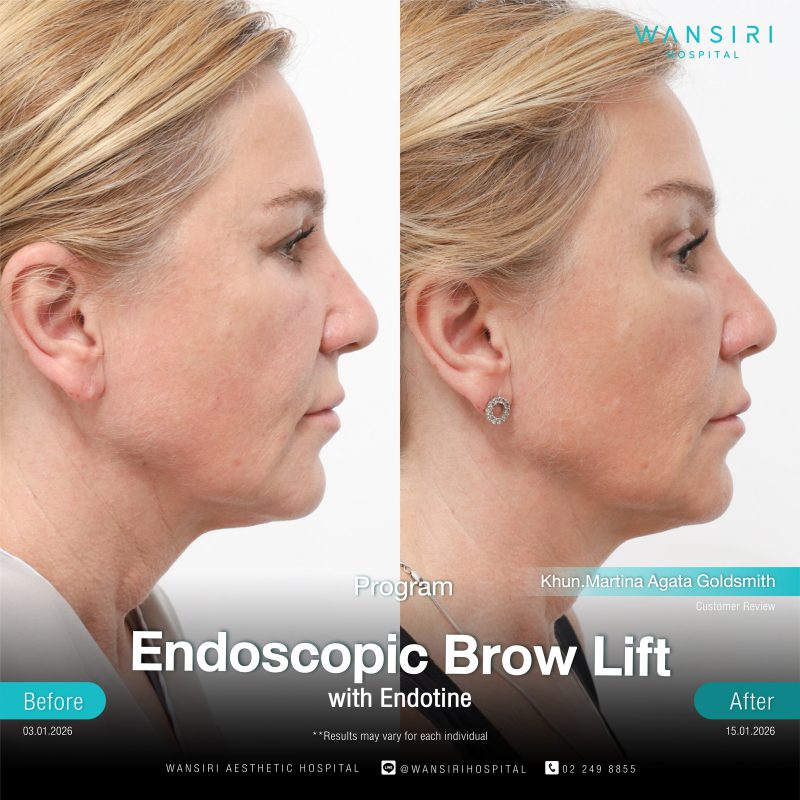
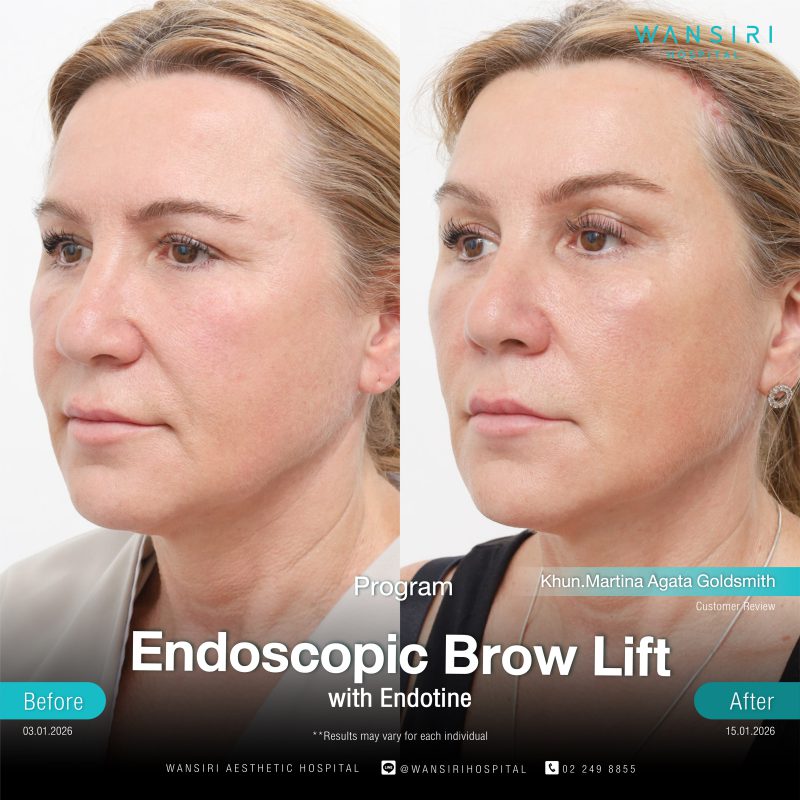
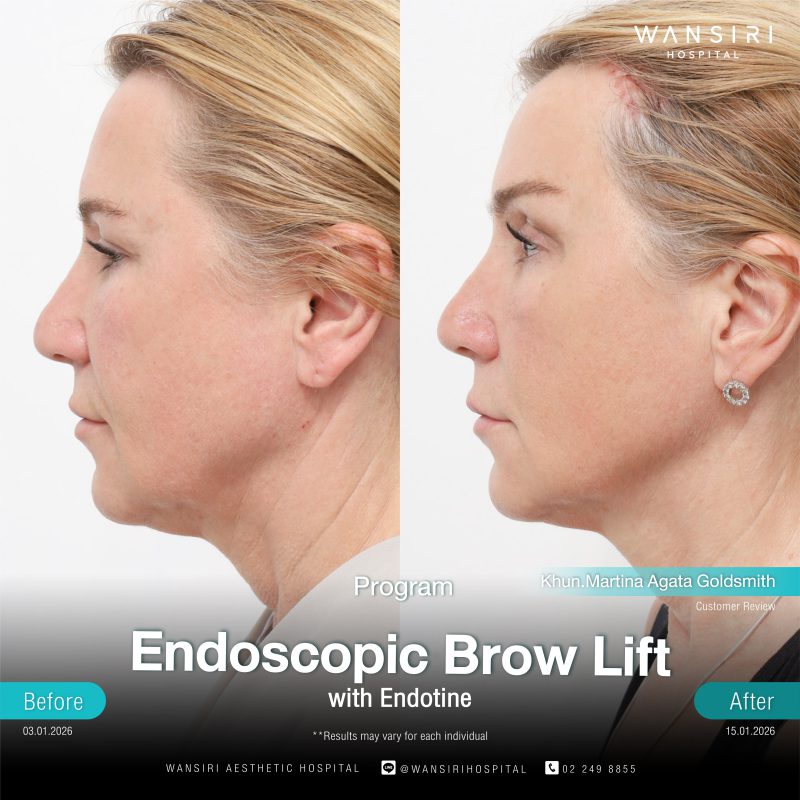
Endoscopic Brow Lift Reviews